

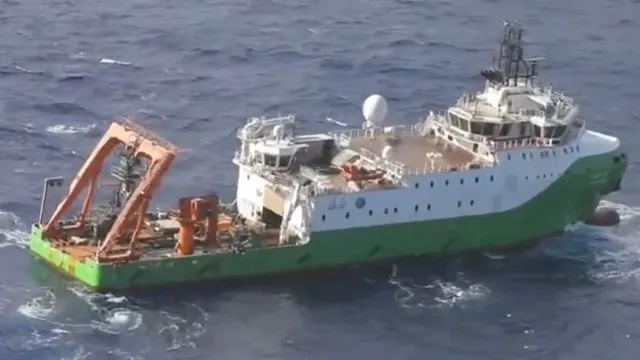
Philippines Coast Guard confronts Chinese vessel for unauthorized operations
Philippines Coast Guard confronts Chinese vessel for unauthorized operations
- On December 30, 2025, the Philippine Coast Guard deployed an aircraft to confront a Chinese research vessel potentially conducting unauthorized research.
- The vessel, CRV Tan Suo Er Hao, was found operating within the Philippine Exclusive Economic Zone without prior consent, violating both Philippine and international maritime law.
- The incident underscores ongoing tensions in the region and highlights the Philippines' commitment to protect its maritime sovereignty against foreign incursions.
Story
The Philippines Coast Guard took significant action on December 30, 2025, when it deployed an aircraft to confront a Chinese research vessel detected approximately 19 nautical miles off the coast of Cagayan, a province in northern Luzon. The vessel, identified as the CRV Tan Suo Er Hao, is a 285-foot long deep-sea research ship operated by the Institute of Deep-Sea Science and Engineering of the Chinese Academy of Sciences. It was suspected of conducting marine research within the Philippine Exclusive Economic Zone (EEZ) without the necessary prior consent, which would violate not only Philippine law but also international law as stipulated by the United Nations Convention on the Law of the Sea (UNCLOS). Upon spotting the vessel, which had previously set sail from Hainan province in China, the Philippine authorities attempted to communicate through radio challenges to ascertain the ship’s intentions regarding its activities. However, the vessel did not respond to these communication attempts. The Philippine Coast Guard indicated that the Chinese vessel had earlier entered the western part of the Philippine EEZ and was seen moving further east, approximately 55.8 nautical miles off Santa Ana in Cagayan. This event coincided with heightened tensions in the region, particularly relating to military activities and maneuvers conducted by China around Taiwan, which were ongoing on that same day, further complicating the diplomatic landscape. The situation reflects the broader maritime disputes in the South China Sea, where China claims extensive territorial rights that conflict with the claims of several neighboring countries, including the Philippines. Recently, such activities have led to confrontations involving the Chinese coast guard. These confrontations have become more pronounced, often involving aggressive tactics such as water cannons and ramming actions aimed at driving away Philippine vessels. Analysts express concerns over the dual functions of China's research vessels, which may not only be conducting scientific inquiries but could also be gathering intelligence that benefits the People's Liberation Army. This raises an alarm over national security issues for the Philippine government. In light of these geopolitical intricacies, the Philippine Coast Guard's spokesperson reiterated their commitment to monitor and challenge unauthorized activities within the nation's EEZ. The incumbent administration under President Ferdinand Marcos Jr. has emphasized the need to uphold national sovereignty over maritime laws, intensifying the country's vigilance against perceived violations from foreign vessels operating in its territorial waters. The Philippine Navy's newly established military bases, which include one in Cagayan accessible for US forces under the Enhanced Defense Cooperation Agreement (EDCA), adds another layer of complexity to the ongoing tensions, as defense cooperation between the Philippines and the United States aims to counteract Chinese assertiveness in the region.


