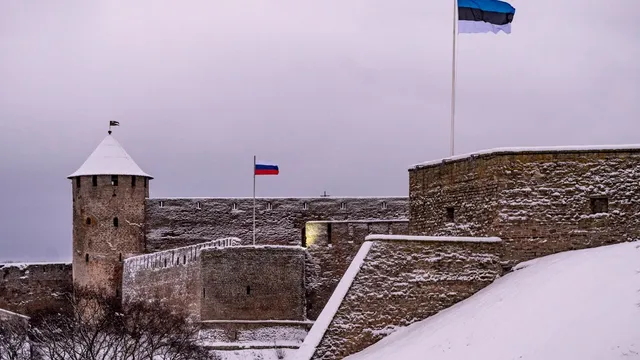
Russian border guards illegally enter Estonia on hovercrafts
military conflicts
impactful
provocative

Russian border guards illegally enter Estonia on hovercrafts

20
(Update: )
sovereign state in Eastern Europe and Northern Asia
intergovernmental military alliance between 31 member states
sovereign state in northeastern Europe
river between Estonia and Russia
  • Three Russian border guards crossed the Estonia-Russia border illegally using hovercrafts.
  • Estonia’s interior minister reported that the guards were not arrested as they returned to Russia before intervention.
  • The incident reflects ongoing concerns about Russian military provocations near NATO borders.
Share opinion
2

Story

On December 17, 2025, three Russian border guards crossed into Estonian territory without permission using hovercrafts, an action that has heightened concerns about Russia's provocations near NATO borders. The incident occurred around 10 a.m. local time at the Vasknarva breakwater on the Narva River, which straddles both Russian and Estonian territories. Surveillance equipment identified the guards in Estonia for approximately 20 minutes, after which they returned to Russia. Estonia's Foreign Ministry responded by summoning the Russian charg d'affaires to express official protest and seek clarification regarding the unlawful incursion. The lack of clarity around the guards' motives remains a concern for Estonian authorities as they ramp up border patrols and security measures. Estonia, a NATO member, shares a significant border with Russia and has expressed ongoing alarm regarding the increasing frequency of Russian military incursions over the past months. These activities include unauthorized drone and aircraft flights over NATO airspace, leading to heightened tensions and military readiness among allied nations. Estonia's Interior Minister Igor Taro emphasized the need for an explanation from Moscow on this latest border incident, noting that the Russian guards had returned to their territory before any intervention could occur. This pattern of behavior has raised alarms about the overall security situation in Eastern Europe and the Baltic states. Moreover, Estonia has been proactively preparing for potential threats from Russia by developing a Baltic Defence Line, aimed at reinforcing its border security. Construction began on December 1, 2025, with plans for bunkers and other defensive structures to be completed over the next two years. In the wake of this incident, the Estonian government is likely to further engage with NATO allies to discuss contingency plans in anticipation of future violations and to ensure the safety of its borders and citizens. Recent events illustrate a worrying trend of aggression from Russia towards neighboring NATO countries, prompting Estonia to review and intensify its defense strategies. The country's leadership is determined to respond firmly to any violation of its sovereignty, as highlighted by the swift response to the incursion by its border guards. In light of this latest incident, it is imperative that both national and international dialogues on security escalations with Russia be prioritized to ensure regional stability and peace in the face of ongoing military provocations from the Kremlin.

Context

In recent years, the situation at the borders of Russia has become increasingly tense, prompting a response from NATO that reflects both the seriousness of the threat and the alliance's commitment to collective defense. The concept of border incursions refers to unauthorized military movements or actions that challenge the sovereignty of neighboring states. These incursions have raised concerns among NATO members, particularly those in Eastern Europe, who fear for their security in the face of Russian assertiveness. The alliance's response has been multifaceted, focusing on deterrence measures, enhanced readiness, and diplomatic efforts to address the underlying tensions. NATO has significantly increased its military presence in Eastern Europe in response to perceived threats from Russia. This includes the deployment of multinational battlegroups in countries such as Poland and the Baltic states, which serves not only as a show of force but also as a reassurance to member states that NATO will defend its territory. Additionally, exercises and training missions have been intensified to improve the interoperability of NATO forces and ensure that they are prepared to respond rapidly to any aggression. The commitment to Article 5 of the NATO Treaty, which states that an attack on one member is an attack on all, continues to be a cornerstone of the alliance's strategy, reinforcing collective security among members. Furthermore, NATO has engaged in various diplomatic initiatives aimed at de-escalating tensions with Russia. Communication channels have been maintained to avoid misunderstandings and to promote transparency regarding military activities. High-level meetings and discussions have occurred, focusing on arms control and confidence-building measures. Despite these efforts, the relationship between NATO and Russia remains strained, fueled by differing perspectives on security, sovereignty, and regional influence. NATO's approach is to balance deterrence with dialogue, recognizing that while the military posture is crucial, political solutions are essential to achieving lasting stability in the region. As the geopolitical landscape continues to evolve, NATO's response to Russian border incursions will likely adapt to new challenges. The alliance is aware of the necessity to remain flexible and responsive to Russia's actions while also preparing for potential scenarios that extend beyond conventional military engagements. Cyber threats, disinformation campaigns, and hybrid warfare tactics are becoming more prevalent and require comprehensive responses that engage not only military capabilities but also civilian sectors and international partnerships. In summary, NATO's response to Russian border incursions illustrates its commitment to collective defense while navigating the complexities of modern security dynamics.

2026 All rights reserved