

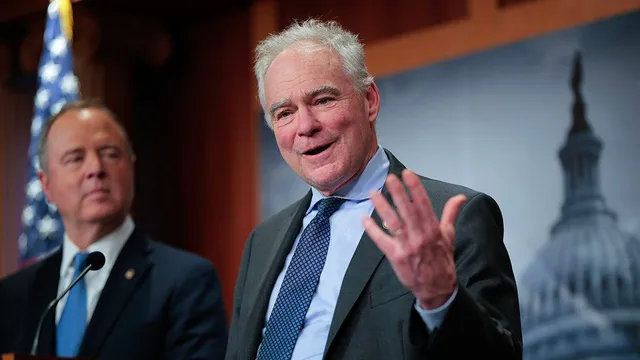
Kaine vows to challenge Trump’s military powers amid failed Venezuela resolution
Kaine vows to challenge Trump’s military powers amid failed Venezuela resolution
- Senator Tim Kaine announced plans to file more war powers resolutions after recent setbacks in limiting Trump's authority.
- Republicans successfully blocked a Democratic-led resolution aimed at restricting military action against Venezuela.
- The ongoing efforts underscore the tense political landscape regarding presidential war powers amidst significant geopolitical concerns.
Story
In the United States, Senator Tim Kaine from Virginia has taken significant steps to rein in the military powers of President Donald Trump, particularly regarding actions in Venezuela. Following the failure of a bipartisan war powers resolution aimed at restricting Trump's military authority in Venezuela, Kaine announced his intention to persist in filing more resolutions. The recent attempts to limit Trump’s powers have been met with a strong partisan divide, with House Republicans successfully blocking a similar resolution that required congressional authorization for military actions. This legislative maneuvering highlights ongoing tensions regarding presidential war powers and congressional oversight in military matters. The recent efforts to curb Trump's military authority stem from a broader concern among several lawmakers about the implications of unilateral military actions. Kaine’s push to limit Trump’s war powers has drawn criticism from Republicans, who argue that his efforts are politically motivated. Kaine had previously succeeded in garnering bipartisan support for a resolution aimed at limiting military action following Trump's orders to kill Iranian General Qassem Soleimani in 2020. However, in the current political landscape, significant pushback from Republican leaders has made it challenging to advance such measures. With the backdrop of ongoing geopolitical tensions and the Trump administration's recent military actions in Venezuela, including the operation targeting President Nicolás Maduro, congressional stakeholders are increasingly aware of the importance of affirming their constitutional authority in matters of war. The administration has assured lawmakers that no U.S. troops are currently on the ground in Venezuela and that any future military operations would seek congressional authorization, though critics remain skeptical. As Kaine prepares to introduce more resolutions, he aims to build bipartisan support to chip away at Republican resistance. His approach is founded on the belief that Congress must reassert its role in decisions leading up to military conflict, reflecting a longstanding debate about the balance between executive authority and legislative oversight over military engagements. This ongoing dialogue within Congress will likely shape the landscape of U.S. foreign policy and military strategy moving forward.
Context
The scope of Congressional authority over military actions has been a critical and longstanding discussion in American politics, reflecting the delicate balance of power enshrined in the U.S. Constitution. The framers aimed to prevent any single branch of government from becoming too powerful, particularly in matters of war and military engagement. Article I, Section 8 grants Congress the authority to declare war, raise and support armies, and maintain a navy, which establishes its fundamental role in determining the nation's military actions. This constitutional provision is foundational to ensuring that military engagements reflect the will of the people, as represented by their elected officials, rather than unilateral actions by the executive branch, thus promoting accountability and deliberation in such grave decisions. Despite this clear constitutional framework, the dynamics of military authority have evolved significantly over the years, often leading to tensions between Congress and the President. While Presidents have generally assumed greater control over military operations, citing their role as Commander-in-Chief provided by Article II, Section 2, Congress has intermittently sought to assert its authority to declare war. Notable examples include the Korean War and the Vietnam War, where U.S. military intervention occurred without formal declarations of war, showcasing how executive interpretations of military authority can sometimes outpace legislative intent. The War Powers Resolution of 1973 was an attempt by Congress to reclaim some of its authority, mandating that Presidents must consult with Congress before engaging in hostilities and must withdraw forces if Congress does not authorize military action within 60 days. However, the effectiveness of the War Powers Resolution has been debated. Many Presidents have viewed it as an infringement on their executive authority, often choosing to bypass its stipulations, thereby raising questions about the balance of authority and the role of Congress in modern military decisions. Critics argue that this tension undermines the intended checks and balances, possibly leading to prolonged military engagements without adequate oversight or input from the legislative branch. Furthermore, in the context of contemporary threats that require rapid responses, the speed of military engagement may necessitate decisive executive action, complicating the implementation of collaborative efforts between the President and Congress. In light of ongoing global conflicts and national security challenges, the discourse on Congressional authority over military actions remains highly relevant. As new military engagements unfold and the landscape of warfare transforms, including the use of advanced technology and cyber operations, the need for clear guidelines regulating executive and legislative powers in military affairs becomes increasingly critical. Ultimately, a careful recalibration of authority may be necessary to ensure that both branches work together effectively to address the complexities of national defense while honoring the constitutional mandates designed to maintain a system of checks and balances.


