

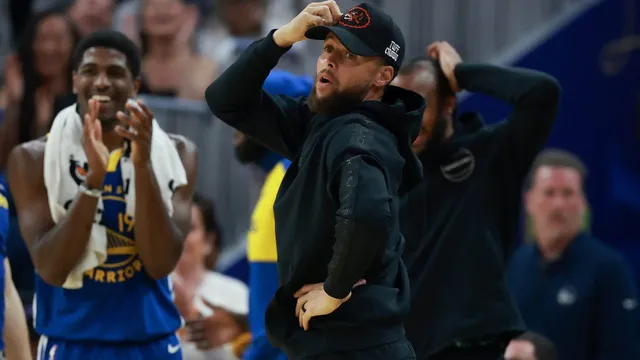
Steph Curry sidelined for at least six more games with knee injury
Steph Curry sidelined for at least six more games with knee injury
- Stephen Curry has been out since January 30, 2026, due to a knee injury.
- The Warriors have posted a 5-10 record without him, significantly impacting their standings.
- Curry's absence presents challenges for the team as they aim to remain competitive in the league.
Story
In the United States, the Golden State Warriors announced that star player Stephen Curry will be sidelined for a minimum of six additional games due to a persistent knee injury, referred to as runner's knee. The announcement, made on March 11, 2026, indicates that Curry will be re-evaluated in 10 days. He has not participated in any games since January 30, 2026, when he played against the Detroit Pistons for 25 minutes before leaving the game early due to discomfort in his right knee. As of now, the Warriors have struggled significantly without their star player, holding a record of 32 wins and 33 losses, which places them ninth in the Western Conference standings. They have experienced a particularly rough patch, winning only five out of their last 15 games, which includes a three-game losing streak. The team had high hopes for Curry's return following the All-Star break, but his ongoing knee issues have thwarted those expectations. Curry's absence is notably harming the team's performance, as they have not managed to recover their footing in the tightly contested Western Conference. The Warriors' next game will be against the Minnesota Timberwolves, followed by a six-game road trip that will take them through various cities before they return home. During this time, the team will need to find a way to perform without one of the league's top scorers. Prior to his injury, Curry had been productive, averaging 27.2 points per game, which highlights how heavily they relied on him for offensive output. The organization remains hopeful that he may return in time to contribute during critical games later this month, particularly against the Atlanta Hawks, but for now, his status remains uncertain as he continues his recovery.
Context
In the realm of professional basketball, injuries can have a profound impact on teams' performance, strategy, and overall season outcomes. The National Basketball Association (NBA) is no stranger to injuries, with players frequently sustaining a variety of ailments that range from minor to career-threatening. These injuries not only affect the individual player's career trajectory but also resonate throughout the entire team, impacting game results, playoff prospects, and team dynamics. When star players are sidelined, teams often struggle to maintain their competitive edge, leading to shifts in offensive and defensive strategies as coaching staff attempt to adapt to the available roster. Injuries can also heavily influence the financial aspects of an NBA franchise. High-profile players on large contracts who are injured can lead to significant losses in revenue due to decreased ticket sales, diminished merchandise sales, and lower television ratings. Moreover, teams may be forced to make roster adjustments, either by signing contracts with lesser-known players or engaging in trades to fill the gaps left by injured athletes. In this context, a team's depth becomes a crucial factor; franchises with a solid bench are better equipped to withstand the shock of losing a key player, allowing them to remain competitive even when injuries occur. The timing of injuries can also be critical, particularly when they occur during pivotal moments in the season, such as the postseason. A team that has successfully navigated through the regular season can see its championship aspirations dashed if a key player is injured at an inopportune moment. Furthermore, the psychological impact of injuries on both players and teams cannot be ignored. The uncertainty that accompanies injuries can lead to decreased morale and confidence among players, which can translate into poorer performance on the court. This psychological struggle is compounded when teams make desperate attempts to compensate for losses, often leading to even more injuries due to increased playing time and pressure placed on healthy players. Consideration of injury impact extends beyond immediate game results and financial considerations; it resonates through the long-term viability of franchises in the highly competitive NBA landscape. Teams that effectively manage injuries through advanced medical protocols, training techniques, and player rotations often find themselves at a competitive advantage. Furthermore, the ability to analyze injury data and trends can aid in preventative measures, allowing organizations to implement strategies that minimize injury occurrence. This focus on health and wellness, alongside traditional basketball fundamentals, represents the evolving nature of team management in the NBA. Overall, the implications of injuries in the NBA are multifaceted and necessitate a comprehensive understanding by teams looking to achieve consistent success.


