Chinese AI start-ups outpace US competitors with cheaper models
technology
impactful
controversial

Chinese AI start-ups outpace US competitors with cheaper models

10
(Update: )
country in East Asia
country primarily in North America
  • Chinese AI start-ups are developing models that rival those from Western companies in performance.
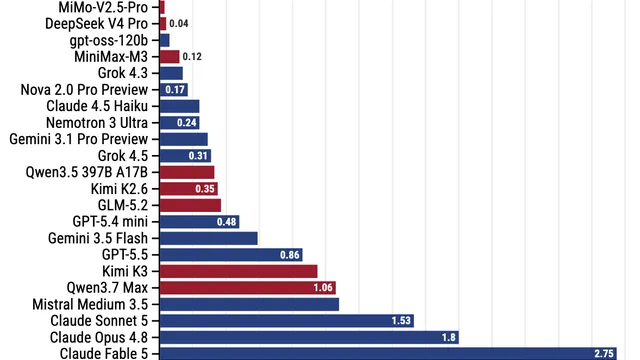
  • These models are significantly cheaper to operate, with costs ranging from two to 33 cents per task.
  • The rise of these efficient models is reshaping the AI industry and increasing competition.
Share opinion
1

Story

In recent months, Chinese artificial intelligence start-ups have made significant strides in developing AI models that can compete with those from Western companies, particularly the United States. These models, produced by companies such as DeepSeek, Z.AI, and Moonshot AI, are not only comparable in performance to systems from OpenAI and Anthropic but are also significantly cheaper to operate. The cost of executing standardized tasks using these Chinese models ranges from two to 33 cents, while the same tasks using Anthropic's Claude Fable 5 can cost as much as $2.75. This stark difference in operational costs highlights the efficiency of the Chinese models. The rise of these cost-effective AI solutions can be attributed to several factors. Chinese start-ups have adopted innovative techniques to enhance efficiency, allowing them to maximize the output from each unit of computing power. This approach has been necessitated by US restrictions on the export of advanced AI chips, which have compelled Chinese companies to find alternative methods to improve their models. As a result, the efficiency of Chinese AI models has increased significantly, making them more appealing to businesses looking to reduce operational costs. Leaders from OpenAI and Anthropic have expressed concerns regarding the rapid advancement of Chinese AI technology. They warn that the emergence of powerful new models from China could lead to a dystopian future for artificial intelligence, posing significant security risks without proper regulation. However, some analysts suggest that these warnings may be more about undermining competition than genuine concern for safety. As the landscape of AI continues to evolve, both Chinese and Western companies are preparing for potential public offerings, indicating a shift in the market dynamics. The competition between Chinese and Western AI models is indicative of a broader trend in global technology. As China continues to establish itself as a hub for industrial manufacturing, it is now applying similar principles to the field of artificial intelligence. The ability to produce comparable technology at a fraction of the cost is likely to reshape the AI industry, leading to increased competition and innovation. The implications of this shift will be felt across various sectors, as businesses seek to leverage the advantages offered by these more efficient and cost-effective AI solutions.

Context

The future of artificial intelligence (AI) regulation is a critical topic as the technology continues to evolve and integrate into various aspects of society. As of July 2026, AI systems are increasingly being utilized in sectors such as healthcare, finance, transportation, and education, raising significant ethical, legal, and social implications. The rapid advancement of AI capabilities, including machine learning and natural language processing, necessitates a robust regulatory framework to ensure that these technologies are developed and deployed responsibly. Policymakers are faced with the challenge of balancing innovation with the need to protect public interest, privacy, and security. Current regulatory approaches vary widely across different jurisdictions, with some countries adopting proactive measures to govern AI development while others lag behind. The European Union has been at the forefront of AI regulation, proposing the AI Act, which aims to establish a comprehensive legal framework for AI systems based on risk assessment. This legislation categorizes AI applications into different risk levels, imposing stricter requirements on high-risk systems, such as those used in critical infrastructure or biometric identification. In contrast, the United States has taken a more decentralized approach, with various states implementing their own regulations, leading to a patchwork of laws that can create confusion and hinder innovation. As AI technologies continue to advance, the need for international cooperation in regulation becomes increasingly apparent. Global challenges, such as climate change, public health, and cybersecurity, require collaborative efforts that transcend national borders. Establishing international standards for AI development and deployment can help mitigate risks associated with the technology while fostering innovation. Organizations such as the OECD and the United Nations are working towards creating frameworks that promote responsible AI use, emphasizing transparency, accountability, and inclusivity in AI systems. Looking ahead, the future of AI regulation will likely involve a dynamic interplay between government oversight, industry self-regulation, and public engagement. Stakeholders, including technologists, ethicists, and civil society, must collaborate to create a regulatory environment that not only addresses current challenges but also anticipates future developments in AI. As society grapples with the implications of AI, it is essential to ensure that regulations are adaptable and forward-thinking, allowing for innovation while safeguarding fundamental rights and values.