

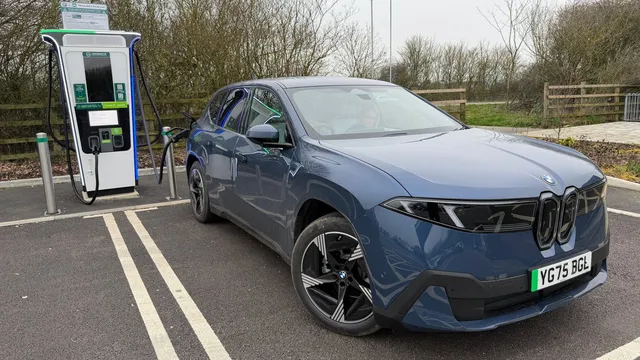
BMW iX3 promises impressive 500 miles but delivers 422 miles in real tests
BMW iX3 promises impressive 500 miles but delivers 422 miles in real tests
- The BMW iX3 was tested over a ten-day journey, covering more than 1,000 miles.
- During the trip, the iX3 showed a potential range of 422 miles at full charge, which was enough for the Liverpool journey.
- Overall, the iX3 performed well for the trip, making it a strong consideration for electric vehicle buyers.
Story
In March 2026, a reviewer tested the BMW iX3 to assess its claimed range of 500 miles on a single charge during a 10-day period covering over 1,000 miles. The primary aim was to determine if the vehicle could fulfill the requirements of long journeys, specifically completing a round trip to Liverpool without needing extensive charging stops. The reviewer noted that while EVs often underperform compared to official claims, the iX3 managed a potential range of 422 miles at full charge, which was sufficient for the round trip. Though the vehicle performed well, it was revealed that efficiency decreases on motorways without regenerative braking. The reviewer experienced a firm ride, which was a minor downside, as passengers noted the driving experience was reminiscent of typical BMW vehicles. They successfully reached Liverpool with 48% battery remaining but were aware that the car's onboard systems frequently prompted charging stops. After charging for 15 minutes at a service station, the reviewer felt reassured about the vehicle's range for the return journey. Overall, while the iX3's performance was commendable, future drivers may need to plan their journeys more carefully. It's clear the iX3 could be a viable option for those looking for an electric vehicle capable of making longer trips with the right planning and charging stops.
Context
As of 2026, the landscape of electric vehicles (EVs) continues to evolve, particularly for those tackling long-distance journeys. The increasing range of electric cars combined with enhanced charging infrastructure indicates a positive shift towards making EVs a viable option for longer trips. Buyers are now looking for vehicles that not only offer substantial range but also comfort, reliability, and advanced technology to enhance the driving experience. Notable features include fast-charging capabilities and driver assistance systems that make long drives more pleasant and secure. Many manufacturers have introduced models specifically designed for long trips, with the Tesla Model S and the Ford Mustang Mach-E leading the pack. The Tesla Model S boasts an impressive range of approximately 405 miles on a single charge, and Tesla's Supercharger network ensures that drivers can quickly recharge during journeys. Additionally, the vehicle's spacious interior and advanced autopilot functionality contribute to a relaxing travel experience. The Mustang Mach-E, with up to 300 miles of range, combines performance with functionality, making it an appealing choice for those seeking long-distance comfort paired with sporty handling. Other contenders include the Hyundai Ioniq 5 and the Kia EV6, both of which offer over 300 miles of range. These models feature ultra-fast charging capabilities that can replenish the battery from 10% to 80% in about 18 minutes, making refueling more efficient during long trips. Furthermore, their spacious interiors and high-quality infotainment systems provide a comfortable environment for passengers. Drivers can also enjoy enhanced safety measures and connectivity features that benefit long-trip conditions. While the array of options is expanding, factors such as charging infrastructure and available range are crucial for those considering an EV for long-distance travel. The increasing installation of fast-charging stations along major roadways alleviates some of the anxieties previously associated with range limitations. As we move deeper into 2026, the focus on sustainability drives technological advancements, resulting in electric cars becoming increasingly popular and practical for extensive travel, affirming their place in the future of transportation.


