

Cuba vows to defend itself against U.S. military aggression
Cuba vows to defend itself against U.S. military aggression
- Cuba has faced significant hardships due to a prolonged U.S. oil embargo leading to food shortages and medicine scarcity.
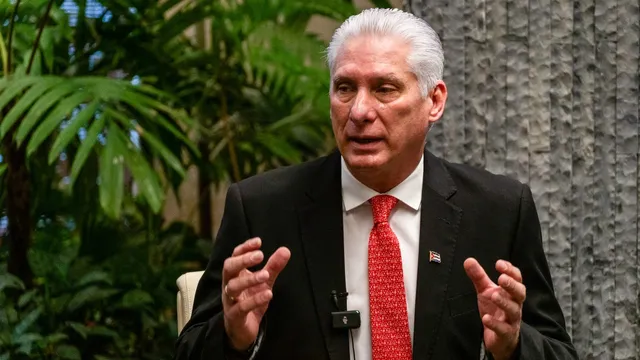
- President Miguel Díaz-Canel expressed Cuba's willingness to defend itself against any U.S. military aggression during a recent interview.
- Díaz-Canel advocates for a respectful and diplomatic approach to resolve tensions with the United States.
Story
In an exclusive interview with Newsweek in Havana, Miguel Díaz-Canel, the President of Cuba, voiced the nation’s readiness to defend itself amidst heightened tensions with the United States. This statement comes in response to threats made by then-President Donald Trump, who discussed possibly taking action against the communist nation, which lies approximately 90 miles from Florida. The comments by Díaz-Canel followed an escalating military rhetoric and a severe U.S. oil embargo that has exacerbated the island’s economic woes, contributing to critical shortages of food and medicine. Cuba, which has been significantly impacted by the blockade enforced by the U.S., has faced rising food prices and frequent anti-government protests. Díaz-Canel, while advocating for diplomacy, emphasized the country's commitment to collective defense, invoking the idea of a
Context
The history of Cuba-U.S. relations has been marked by a complex interplay of diplomatic, economic, and political factors that reflect the interests and ideologies of both nations. Following Cuba's independence from Spain in 1898, the U.S. emerged as a dominant player in Cuban affairs, culminating in the Platt Amendment of 1901, which allowed for significant American intervention in Cuban government and affairs. Over the ensuing decades, this relationship evolved, with the U.S. exerting considerable control over Cuba's economy and political landscape, particularly in the sugar and tobacco industries. The rise of nationalism in Cuba, especially under the leadership of Fulgencio Batista, set the stage for shifting dynamics as many Cubans began to resent U.S. dominance and interventionism. The Cuban Revolution of 1959 marked a dramatic turning point in U.S.-Cuba relations. Led by Fidel Castro, the revolutionaries overthrew Batista, establishing a socialist state that aligned more closely with the Soviet Union. America’s response was immediate and severe, culminating in the U.S. imposing an economic embargo against Cuba in 1960, aimed at isolating the country and undermining its socialist regime. This was followed by the Bay of Pigs invasion in 1961, a failed attempt by U.S.-backed Cuban exiles to overthrow Castro. The Cuban Missile Crisis of 1962 further escalated tensions, bringing the two nations to the brink of nuclear war and solidifying a period of hostility that would last for decades. Throughout the latter half of the 20th century, Cuba remained largely isolated, navigating a contentious relationship with the U.S. while becoming a strong ally of the Soviet Union. The embargo severely impacted Cuba’s economy, leading to a series of hardships for its citizens. Despite numerous attempts at diplomacy, including both countries’ participation in various international forums and discussions about potential normalization, substantive changes were slow to materialize. It wasn't until the Obama administration in the 2010s that significant steps towards rapprochement were taken, including the easing of travel restrictions and the reopening of embassies, representing a period of cautious optimism about the future of relations between the two countries. However, the election of Donald Trump in 2016 brought the pendulum of U.S.-Cuba relations back toward hostility, as the administration rolled back several Obama-era policies, reimposing restrictions on commerce and travel. As of April 2026, relations remain strained, with ongoing debates about the effectiveness of the embargo and the potential for future diplomatic engagement. Furthermore, the emergence of new leaders on both sides and changing geopolitical landscapes may influence how Cuba and the U.S. interact moving forward. Historical patterns suggest that while moments of cooperation may occur, fundamental ideological differences and national interests will continue to shape the trajectory of Cuba-U.S. relations.


