

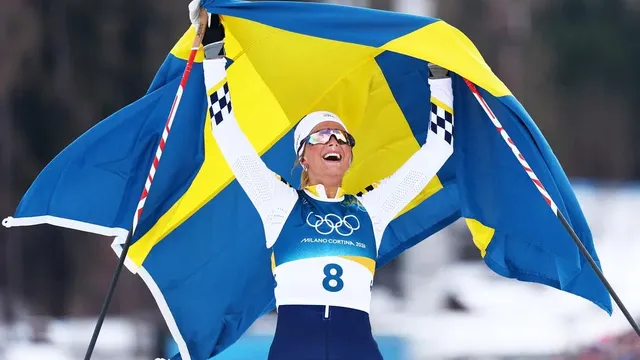
Frida Karlsson secures gold in women's skiathlon at Milano Cortina Games
Frida Karlsson secures gold in women's skiathlon at Milano Cortina Games
- Frida Karlsson led the Swedish team to victory in the women's skiathlon at the Milano Cortina Games.
- She finished 51 seconds ahead, securing her first individual gold medal.
- The event showcased a strong performance from Sweden, with Ebba Andersson taking silver and Heidi Weng of Norway capturing bronze.
Story
In the first cross-country skiing race of the Milano Cortina Games, which were held in Tesero, Italy, Sweden showcased its strength by dominating the women's skiathlon event. This competition featured two segments: a 10km classic skiing race followed by a 10km freestyle. Frida Karlsson led the Swedish charge, finishing with an impressive advantage over her competitors. Her exceptional performance marked a significant milestone as it was her first individual medal, following a bronze she earned in the women's relay at the 2022 Beijing Olympics. Standout finishes included her compatriot Ebba Andersson, who secured the silver medal, and Norway’s Heidi Weng, who claimed the bronze. The classic skiing segment was competitive, with Karlsson and Andersson initially racing closely within a tight group that included several other Scandinavian skiers. However, as they transitioned into the freestyle portion, Karlsson broke free, establishing a lead that extended to 51 seconds by the finish line. Notably, she had the opportunity to celebrate by waving the Swedish flag before officially crossing the finish. Amidst the excitement, world-renowned competitor Jessie Diggins of the United States faced a challenging race after a fall early on due to a sharp downhill turn. Although she was able to regain some ground during the freestyle segment, she ultimately finished in eighth place and acknowledged the difficult circumstances she encountered during the classic portion. Karlsson expressed her elation post-race, emphasizing her pride in the Swedish team and acknowledgment of the outstanding performance by her skis. This event served as a reminder of the intense competition within cross-country skiing and reaffirmed Sweden's status as a powerhouse in the discipline.
Context
Cross-country skiing has a rich history in Sweden, where it has been embraced as both a sport and a cherished national pastime. The origins of cross-country skiing in Sweden can be traced back to ancient practices of using skis for transportation during winter, which gradually evolved into a competitive sport. By the late 19th century, cross-country skiing began to organize into formal competitions, with Sweden emerging as one of the leading nations in this discipline. The establishment of the Swedish Ski Association in 1905 marked a significant turning point, as it helped to promote the sport across the country and laid the foundation for international competition. Throughout the 20th century, Swedish athletes made remarkable strides in cross-country skiing competitions, particularly in events like the FIS Nordic World Ski Championships and the Winter Olympics. Sweden was notably successful in the early Olympic Games of cross-country skiing, with athletes such as Sigvard Rognan and the legendary Gunde Svan achieving substantial victories. The nation's athletes have consistently demonstrated exceptional talent and determination, earning numerous medals and accolades, which solidified Sweden's reputation as a powerhouse in the sport. The late 20th and early 21st centuries saw a new generation of Swedish cross-country skiers rise to prominence. Athletes like Charlotte Kalla, who won multiple Olympic medals, and Marcus Hellner, who made his mark in international skiing, have continued this proud tradition. Their success has not only showcased individual talent but also highlighted Sweden's strong commitment to fostering young talent through national training programs and community support. Coaches and ski clubs play a vital role in the development of aspiring athletes, ensuring the continuation of Sweden's dominance in cross-country skiing. As of 2026, cross-country skiing remains an integral part of Sweden's culture, with the sport enjoying wide participation across all age groups. The country celebrates its rich skiing heritage through various events and festivals that bring together athletes and enthusiasts alike. Moreover, the integration of technology and increasing public interest has further enhanced the sport's profile, ensuring it remains a staple of Swedish winter sports. With a legacy steeped in history, Sweden continues to build on its success in cross-country skiing, inspiring future generations of skiers to strive for excellence.


