

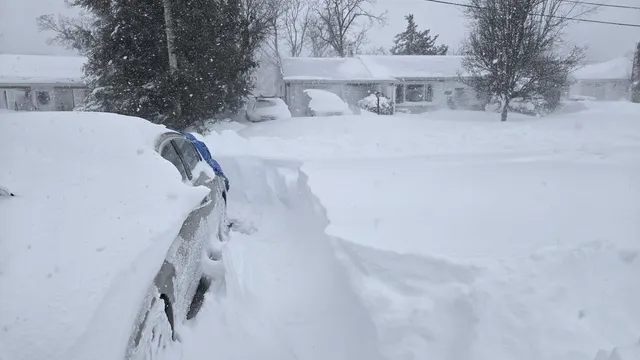
Providence breaks snowstorm record with historic blizzard accumulation
Providence breaks snowstorm record with historic blizzard accumulation
- Providence, Rhode Island set a new all-time snowfall record during the Blizzard of 2026 with 32.8 inches by Monday afternoon.
- The storm brought severe blizzard conditions, including hurricane-force winds that led to travel bans and widespread power outages.
- The Blizzard of 2026 has set a new benchmark for snowfall in the region, highlighting the necessity for better preparedness for extreme weather.
Story
In the United States, a historic blizzard swept through the Northeast on February 23, 2026, marking an unprecedented weather event. Providence, Rhode Island, experienced its largest snowfall ever, accumulating 32.8 inches as the storm raged through Sunday evening into Monday morning. This record-breaking storm not only surpassed the city’s previous snowstorm record set in 1978 but also significantly disrupted daily life across the entire region. Wind gusts reached 60 mph, causing blizzard conditions characterized by heavy, low-visibility snow. As the blizzard unfolded, it affected major cities, forcing travel bans and shutting down essential services. Areas in Massachusetts and Connecticut faced similar challenges, with Boston recording 17.1 inches of snow while New York City reached 19.7 inches. Many towns experienced widespread power outages, affecting hundreds of thousands of residents, especially in Massachusetts, where more than 250,000 customers were without electricity early Tuesday. Rescue and clean-up efforts began as the storm began to lift, with many travel bans being lifted by the following day. Public transportation in cities such as New York and Philadelphia started resuming operations, albeit with reduced services. Communities began to dig out and assess the damage caused by significant snow accumulation in their areas. The storm’s aftermath has led to discussions surrounding urban infrastructure's resilience to extreme weather events. The Blizzard of 2026 has become a benchmark against which future snowfall events in the region will likely be compared. It highlights the increasing severity of winter storms and emphasizes the need for better preparedness in the face of climate-related weather extremes. The historical significance of this event will be referenced for many winter seasons to come as communities adapt to a changing climate.
Context
Climate change is increasingly recognized as a significant factor influencing extreme winter weather events. Historically, winter weather events were largely attributed to natural climatic variations, but recent scientific findings point towards a strong correlation between anthropogenic climate change and the frequency and intensity of these events. As global temperatures rise due to greenhouse gas emissions, the interactions between oceanic and atmospheric systems are altered, contributing to unusual winter phenomena such as heavy snowfall, extended cold spells, and severe wind chills. This evolving climate narrative underscores the need for urgent action to mitigate the ongoing impacts of climate change on our weather systems. One of the key mechanisms through which climate change affects winter weather is the warming of the Arctic, which plays a crucial role in the global climate system. As Arctic temperatures rise significantly faster than the rest of the planet, the temperature gradient between the polar and equatorial regions weakens. This disruption slows down the jet stream, which normally helps maintain stable weather patterns. When the jet stream becomes wavy and erratic, it can lead to prolonged periods of extreme cold in mid-latitude regions, as cold Arctic air spills southward, resulting in severe winter weather events. This change is supported by a growing body of research highlighting how Arctic amplification can contribute to a higher incidence of winter storms and associated freezing conditions. Additionally, the increased moisture content in the atmosphere, due to higher temperatures, leads to more intense precipitation events, including heavy snowfalls during winter months. Warmer air holds more moisture, which can aggravate weather systems causing extreme winter storms. These storms manifest as blizzards in some areas, leading to infrastructure strain, transportation disruptions, and increased risks to public safety. The increase in such extreme events has raised significant concerns regarding preparedness and community resilience, prompting calls for improved forecasting methods and infrastructure adaptations to cope with the increasing unpredictability of winter weather. In conclusion, the interplay between climate change and extreme winter weather is complex and multifaceted. The rise in global temperatures not only intensifies winter storms but also alters fundamental atmospheric patterns that govern weather systems. As research continues to evolve, it is imperative for policymakers, stakeholders, and communities to understand these dynamics to develop effective strategies for mitigation and adaptation. The evidence suggests that addressing climate change is essential not only for reducing the severity of winter weather events but also for ensuring the overall safety and well-being of populations at risk.


