

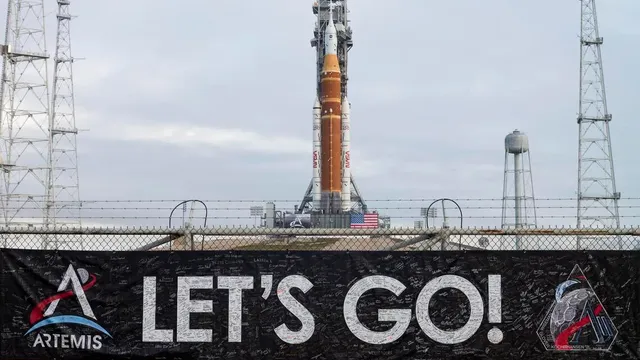
NASA prepares for lunar mission amid growing competition with China
NASA prepares for lunar mission amid growing competition with China
- Four astronauts are undergoing a 14-day quarantine to limit exposure to illnesses ahead of the Artemis II mission.
- The mission will be the first crewed voyage around the Moon in over 50 years, with planned launch in February.
- The Artemis program is crucial for scientific exploration, economic development, and maintaining military dominance in space.
Story
In the United States, four astronauts have entered a health stabilization program, known as quarantine, in preparation for the Artemis II mission set to launch next month. The mission marks the first crewed flight to lunar orbit since Apollo 17, which took place in December 1972. NASA astronauts Reid Wiseman, Victor Glover, Christina Koch, and Canadian astronaut Jeremy Hansen are engaging in a two-week quarantine to reduce their risk of contracting illnesses ahead of the launch from the Kennedy Space Center in Florida. This 10-day mission aims to circle the Moon and safely return to Earth, directly contributing to NASA's broader Artemis program, which seeks to return humans to the lunar surface for the first time since Apollo 17. NASA has set the Artemis III mission, intended for the crewed landing on the Moon, for 2028. This initiative is viewed as a strategic effort amidst growing competition from China, which is pursuing its own lunar goals. Experts have highlighted the importance of establishing a long-term presence on the Moon for scientific exploration and potential resource mining. This race signifies not only a leap in scientific discovery but also the potential for economic benefits and military advantages in space. Furthermore, recent developments in Chinese space capabilities demonstrate the urgency of the American initiative to maintain leadership in lunar exploration and operations.
Context
The NASA Artemis program is an ambitious initiative designed to return humans to the Moon and establish a sustainable human presence there by the end of the decade. As of January 2026, the program is progressing toward its goals with several milestones achieved and additional missions planned. The Artemis I mission, which successfully launched on November 16, 2021, marked a significant step forward in testing the Space Launch System (SLS) and Orion spacecraft. This uncrewed mission completed a 25.5-day journey, validating critical technologies and demonstrating the capabilities needed for future crewed missions. Following this, Artemis II, currently scheduled for 2024, aims to carry astronauts on a lunar flyby, further validating crew operations and systems under real spaceflight conditions. It represents a vital precursor to surface exploration aimed for the subsequent missions under the Artemis program. NASA's Artemis III is planned to land astronauts on the lunar South Pole in 2025, where they will conduct scientific research and geology studies that could unlock key insights into the Moon's history and resources, particularly water ice. The Artemis program also emphasizes the importance of international and commercial partnerships. NASA has collaborated with various space agencies and private companies to develop innovative technologies for lunar exploration. The Artemis Accords, which outlines principles for international cooperation in space exploration, has garnered support from numerous countries, enhancing the program's global significance and promoting peaceful exploration. In addition to its lunar objectives, the Artemis program serves as a crucial stepping stone to Mars exploration. By establishing a sustainable presence on the Moon, NASA aims to test systems, technologies, and operational approaches that will be essential for future crewed missions to the Red Planet. Key programs, such as the Lunar Gateway, which will serve as a multi-national outpost orbiting the Moon, are being developed as part of the Artemis initiative. This platform will provide vital support to lunar missions and facilitate deeper space exploration. As of now, the Artemis program faces some challenges, such as budget constraints and delays in some of its components. However, the commitment to meet its ambitious timelines remains strong, with ongoing assessments to overcome these obstacles. Public interest and support for lunar exploration have significantly increased, fostering an environment where both governmental and commercial stakeholders are keen to invest their resources. The Artemis program is not only a mission to the Moon; it is a strategic effort that aims to inspire generations, push the boundaries of human exploration, and pave the way for humanity's eventual journey to Mars.


