

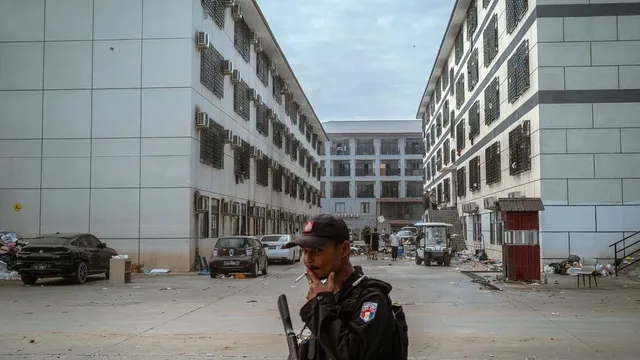
Scammers thrive in massive office park operating from Myanmar
Scammers thrive in massive office park operating from Myanmar
- A sprawling office park developed in Myanmar in 2024, aimed at orchestrating scams on a global scale.
- The facility employed over 3,500 people from nearly 30 nations, simulating legitimate business environments.
- The rise of such operations underscores the need for greater preventive measures against global scams.
Story
In Myanmar, a large office park known as Shunda Park emerged in 2024, dedicated to scams and located in a volatile southeast Asian region. The area, characterized by dense rainforest, was transformed into a bustling center, employing over 3,500 workers from various countries including Kentucky and Kazakhstan. This rapid development reflects the increasingly opportunistic nature of the global scam industry, leveraging the chaos of the borderlands for their advantage. The premises contained expansive rooms filled with computer monitors, advertising slogans aimed at motivating workers, and mock business environments designed to give the impression of legitimacy. The workers at Shunda Park were part of a larger framework that mapped a deceitful operation targeting individuals and businesses worldwide, reflecting an organized and rampant phenomenon. Concealed within Myanmar's challenging landscape, these scammers replicated successful business settings with visual cues such as motivational quotes and misleading decor intended to foster an illusion of productivity and success. Economic factors such as local instability and regulatory gaps contributed to the proliferation of these scams, enabling them to draw in employees from diverse backgrounds under a façade of opportunity. The office park's operations have far-reaching implications for victims across the globe, with individuals from multiple countries falling prey to various fraudulent schemes orchestrated from this one location. This phenomenon illustrates not only the adaptability of scam operations but also the challenges associated with regulating such activities in places where the law might be ineffective or purposely ignored. As this type of crime grows in sophistication, more effective international cooperation and local enforcement mechanisms become vital in protecting unsuspecting individuals. Shunda Park serves as a stark reminder of the darker elements of globalization, where individuals from dozens of nations converge to participate in scams that can have devastating effects on victims far away. The urgent need for greater awareness and education on such scams is crucial to prevent further exploitation, underscoring the resilience and adaptability of criminal enterprises in an increasingly interconnected world.


