politics
controversial
provocative

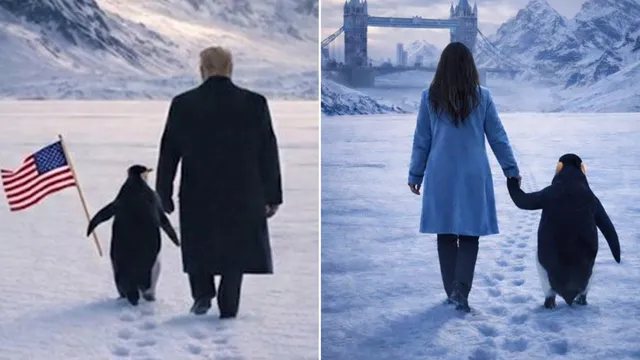
White House uses penguin meme to humorously push for Greenland control

Jan 24, 2026, 3:20 AM40
(Update: Jan 26, 2026, 11:40 AM)
president of the United States from 2017 to 2021
autonomous country within the Kingdom of Denmark on world's largest island by the same name
country primarily in North America

White House uses penguin meme to humorously push for Greenland control

  • The White House shared a meme featuring President Trump and a penguin to highlight its claim over Greenland amid ongoing negotiations.
  • The post was met with criticism for incorrectly associating penguins with Greenland, as they primarily live in Antarctica.
  • This incident illustrates the tension and ridicule surrounding U.S. geopolitical strategies, especially concerning Arctic sovereignty.
Share opinion
Tip: Add insight, not just a reaction
4

Story

In January 2026, the White House shared a meme depicting President Donald Trump crossing ice in what is purportedly Greenland, featuring a penguin holding an American flag. This post came amid ongoing U.S. efforts to assert control over Greenland, a territory belonging to Denmark. Trump indicated that further details about a proposed Greenland framework could be revealed in about two weeks, despite previous pushback from NATO and Danish officials regarding sovereignty concerns. The meme sparked strong reactions online, highlighting a mix of ridicule and criticism aimed at the administration for its misleading portrayal of Arctic geography, where penguins do not inhabit Greenland. In response to the White House's meme, Chinese state-run news agency Xinhua mocked the administration for using the 'Nihilist penguin' meme, noting that penguins live in Antarctica, not the Northern Hemisphere. The Chinese journalist pointed out the geographical error by stating that the only penguin species found north of the equator is the Galapagos penguin. This social media exchange underscores tensions surrounding the U.S. and China’s respective ambitions regarding Greenland, where the U.S. has sought to negotiate military and mineral rights. Former Canadian officials and economists were quick to criticize Trump, with one calling the administration's handling of the situation a 'clown show.' While Trump attempted to link Greenland’s potential access to U.S. security interests and mineral resources, officials in Copenhagen firmly reiterated that any discussions must respect Greenland’s territorial integrity. Furthermore, skepticism surrounds the practical execution of Trump's proposed framework, with officials remaining guarded about its implications. This incident reflects not just a meme gone awry but broader diplomatic challenges as the U.S. navigates international relationships around Greenland. Trump's remark about providing military access and the rights to mine rare minerals has raised eyebrows, stirring debates over international law and the ethics of territorial claims. As the issue unfolds, it raises critical questions about how global powers interact in the Arctic region and the importance of accurate communications regarding international sovereignty and resource control.

Context

Greenland's natural resources play a crucial role in the global economy and environmental sustainability. The island is rich in minerals, particularly rare earth elements, which are essential for the production of high-tech devices, renewable energy technologies, and various other advanced applications. The Arctic region, renowned for its vast mineral potential, is increasingly becoming a focal point for geopolitics as nations seek to secure access to these valuable resources. This dynamic positioning underscores the importance of responsible resource management, ensuring that economic gains do not compromise environmental stability or the rights of indigenous communities residing in these regions. The potential for mineral extraction is not the only factor highlighting Greenland's significance. The region's growing investment in clean energy resources, such as hydroelectric power and wind energy, serves as a model for sustainable development. Greenland's substantial hydropower resources can potentially meet the energy demands of its population and contribute to regional energy security. By harnessing these renewable sources, Greenland can lead the charge in reducing dependence on fossil fuels and showcasing a blueprint for other nations looking to transition to greener energy practices. Moreover, Greenland's vast fishing grounds offer another vital resource, not only for the local economy but also for global food security. The fishing industry is fundamental to Greenlandic society, providing livelihoods and sustaining communities. As climate change continues to alter ocean dynamics, Greenland's fisheries may also shift, making it essential to adopt adaptive management practices to ensure sustainable exploitation of these aquatic resources. The sustainable management of fisheries is paramount for maintaining biodiversity and the health of marine ecosystems, which are inextricably linked to Greenland's cultural identity and future economic prospects. In conclusion, the importance of Greenland's natural resources cannot be overstated. They present significant opportunities for economic growth while also posing challenges that require careful navigation. Emerging economies and foreign investors are keenly aware of the potential that Greenland holds, emphasizing the need for strategic policies that prioritize sustainability, protect the rights of indigenous peoples, and address the impacts of climate change. Strategic partnerships and collaborative efforts among stakeholders will be essential to maximize Greenland's resource potential while safeguarding its environment and cultural heritage.

2026 All rights reserved