

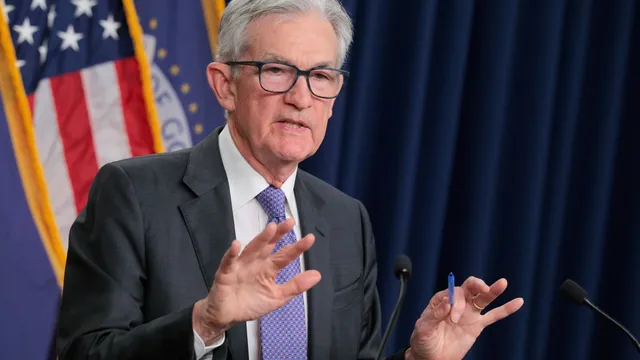
Federal Reserve cuts interest rates, hints at future adjustments
Federal Reserve cuts interest rates, hints at future adjustments
- On December 10, 2025, the Federal Reserve cut the federal funds rate to a range of 3.5% to 3.75% for the third consecutive time.
- The U.S. stock market showed positive reactions, nearing all-time highs following this decision.
- Continued uncertainty regarding inflation and economic conditions may limit further rate cuts in the near future.
Story
On December 10, 2025, the Federal Reserve announced its third consecutive interest rate cut, reducing the benchmark federal funds rate by 25 basis points to a range of 3.5% to 3.75%. This move was largely expected as part of ongoing efforts to bolster a weakening job market, which has shown signs of struggle amid rising inflation pressures. Fed Chair Jerome Powell indicated a more cautious approach in the bank's future monetary policy adjustments, suggesting that additional rate cuts may be limited to just one in 2026 due to persistent inflation levels above the 2% target. The implications of this rate cut have been reflected in the optimism of the U.S. stock market, which is nearing its all-time high as investors reacted positively to statements from Powell that hinted at the possibility of additional cuts down the line. Positive market responses were seen with the S&P 500 climbing 0.7% and the Dow Jones Industrial Average increasing by 1%. Despite this positive market response, there remains uncertainty surrounding inflation and labor market statistics, which have been weighing on economic forecasts. The mixed reaction in Asian markets was observed the day after the rate cut, with shares fluctuating in response to the news from the U.S. The Nikkei 225 dropped by 1% while Hong Kong's Hang Seng edged up slightly. Investors are concerned about forthcoming economic reports, especially from China, as the region's economic data has reflected weaker consumer demand lately, raising flags about global economic stability. Analysts suggest that while the Fed's latest actions have re-established some investor confidence, caution remains due to the unclear economic landscape. Policymakers' projections have signaled only minimal cuts in the coming years, indicating that the central bank is proceeding carefully against a backdrop of mixed economic signals. The rate suppression is not expected to lead to substantial decreases in mortgage rates immediately, and housing market affordability issues persist, likely prolonging the current market dynamics heading into 2026.
Context
The impact of Federal Reserve interest rate cuts on the job market is a significant area of study in economic policy. When the Federal Reserve reduces interest rates, it aims to stimulate economic activity by making borrowing cheaper. Lower interest rates can lead to increased consumer spending, business investment, and improved overall economic conditions. In theory, as businesses invest more in expansion and production, this should lead to job creation and potentially lower unemployment rates. Furthermore, reduced interest rates can encourage consumers to take out loans for large purchases, such as homes and cars, resulting in higher demand for goods and services, which in turn can also drive employment growth across various sectors. Historical data indicates that past interest rate cuts have often correlated with positive shifts in labor markets. For instance, the aggressive rate cuts during the 2008 financial crisis were aimed at counteracting the severe downturn in jobs. In subsequent years, as interest rates remained low, the economy saw significant job growth as businesses adjusted to the more favorable borrowing conditions. However, the timing and effectiveness of these rate cuts can vary based on other economic factors, including inflation, consumer confidence, and global economic conditions. Nonetheless, it is crucial to acknowledge that the relationship between interest rate cuts and job market improvements is not always straightforward. In some cases, businesses may be hesitant to hire even when borrowing costs decline, due to uncertain economic outlooks or structural changes in industries. Moreover, job growth from rate cuts can be uneven, often favoring certain sectors over others. Sectors like construction and manufacturing might benefit significantly from lower rates, while service-oriented industries might experience lagged responses. Additionally, the long-term implications of sustained low interest rates can lead to other economic challenges, including asset bubbles and income inequality, which can ultimately affect job creation negatively. As we look at the current economic conditions, it is clear that the Federal Reserve's monetary policy plays a crucial role in shaping job market dynamics. The effectiveness of interest rate cuts remains contingent on various external factors, including fiscal policy, labor market conditions, and global economic trends. Policymakers must consider these elements when making decisions, as they directly influence the ability of rate cuts to spur job growth effectively. Going forward, ongoing monitoring and analysis will be essential to understand the evolving relationship between Fed policy and employment trends in a rapidly changing economic landscape.


