

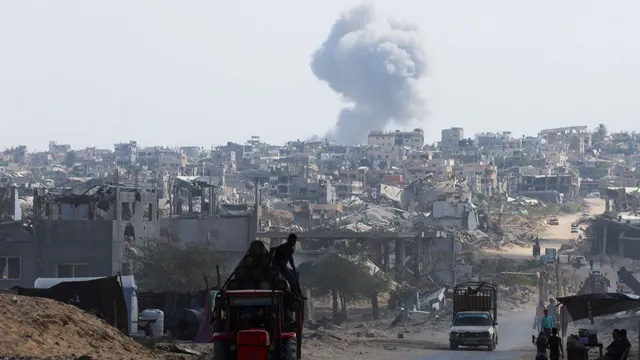
Netanyahu vows to block Palestinian state establishment amid UN debate
Netanyahu vows to block Palestinian state establishment amid UN debate
- Prime Minister Netanyahu has been firm on rejecting Palestinian statehood, asserting no change in Israel's policy.
- The U.N. Security Council is set to vote on a U.S. resolution regarding Gaza that highlights potential Palestinian independence.
- The ongoing situation underscores the complexities of Israeli-Palestinian relations and the challenges of establishing lasting peace.
Story
In Israel, Prime Minister Benjamin Netanyahu reaffirmed his longstanding opposition to the establishment of a Palestinian state on November 15, 2025. This declaration came just one day before the U.N. Security Council was scheduled to vote on a U.S.-drafted resolution regarding Gaza, which suggests a potential pathway for Palestinian self-determination and statehood. The U.N. proposal has faced criticism from Russia, China, and various Arab nations, which highlights the geopolitical complexities surrounding the issue. The U.S. plan, while under international pressure to revise stronger assertions about Palestinian independence, has made no significant shifts in Netanyahu's anti-Palestinian state stance. Simultaneously, violence in the West Bank has been escalating, where Israeli military fire has resulted in multiple Palestinian casualties, drawing further scrutiny towards Israel’s governing policies. Palestinians reported that a 19-year-old was killed by Israeli forces, marking the seventh fatal incident in recent weeks attributed to military actions. Critics of the Israeli government argue that settler violence is widespread, perpetuated by extremist groups, and is often ignored by officials who deem it as actions of a few individuals. Netanyahu described the settler violence as limited, creating tension between official narratives and the lived experiences of many Palestinians. U.S. Secretary of State Marco Rubio expressed concern that the escalating violence in the West Bank could undermine peace efforts in Gaza, where Netanyahu's administration is under intense scrutiny due to its handling of regional security. Reports noted over 260 attacks by Israeli settlers in October, suggesting a significant rise in incidents of violence against Palestinians and their property. Human rights organizations have criticized the Israeli government for creating an atmosphere of impunity for settlers, especially under a government that includes far-right elements that support settlement expansion. As the situation unfolds, both the U.S. and Israel continue to position themselves against Palestinian statehood amidst significant pushback from international bodies and humanitarian groups. Trump's Gaza peace plan, viewed as pivotal for future negotiations, faces skepticism as it attempts to balance Israeli security concerns with Palestinian aspirations for sovereignty. Netanyahu's rigid approach to Palestinian statehood underscores the deep divides and persistent challenges in achieving lasting peace in the region.
Context
The Israel-Palestine conflict is a long-standing and deeply rooted struggle, primarily over land and national identity, that has persisted for more than a century. This conflict traces its origins back to the late 19th century when nationalist movements began to gain momentum, particularly among both Jews and Arabs in the Middle East. Zionism emerged as a movement advocating for the establishment of a Jewish homeland in response to widespread antisemitism in Europe. Concurrently, Arab nationalism was rising as Arabs sought independence and self-determination from colonial rule. Tensions escalated in the early 20th century as Jewish immigration to Palestine increased, leading to conflict over land ownership and political rights between the Jewish and Arab populations, culminating in violence and unrest during the British Mandate of Palestine (1920-1948). In 1947, the United Nations proposed a partition plan to create separate Jewish and Arab states, which was accepted by Jewish leaders but rejected by Arab leaders. This led to the first Arab-Israeli war in 1948 following the declaration of the State of Israel, resulting in the displacement and exodus of approximately 700,000 Palestinians—a event known as the Nakba, or catastrophe. The aftermath of the war saw Israel expanding its territory beyond the UN-designated borders, while the West Bank was occupied by Jordan and the Gaza Strip by Egypt. The conflict remained unresolved, with subsequent wars in 1967, 1973, and ongoing hostilities leading to further territorial changes and the establishment of Israeli settlements in the occupied territories. The late 20th and early 21st centuries saw various efforts toward peace, including the Oslo Accords in the 1990s, aimed at creating a framework for resolving the conflict through mutual recognition and the eventual establishment of a Palestinian state alongside Israel. However, peace efforts have repeatedly stalled due to ongoing violence, retaliatory actions, and political divisions on both sides. The rise of Palestinian political factions, such as Hamas, which opposes the concept of a negotiated two-state solution, has further complicated peace negotiations. Additionally, continued Israeli settlement activity in the West Bank and the blockade of Gaza have heightened tensions, leading to recurrent cycles of violence and humanitarian crises. As of 2025, the Israel-Palestine conflict remains unresolved, marked by deep-rooted grievances, mutual distrust, and regional implications involving neighboring Arab states and broader geopolitical interests. International parties continue to advocate for a peaceful resolution; however, achieving a lasting peace remains a challenge due to the complexities of historical narratives, territorial claims, and the interplay of local and international politics. The future of Israel and Palestine remains uncertain, with the possibility of either renewed conflict or a concerted effort toward reconciliation and coexistence hanging in the balance.


