

U.S. government issues warning after El Mencho's death in Mexico
U.S. government issues warning after El Mencho's death in Mexico
- Mexican military killed Nemesio Oseguera Cervantes, known as El Mencho, resulting in increased violence across the country.
- U.S. officials warned cartels against targeting American citizens during the chaos following El Mencho's death.
- The situation underscores the need for U.S. action to address the spillover of cartel violence into American territory.
Story
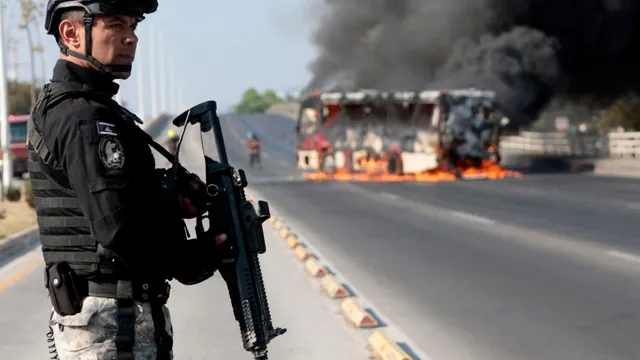
In Mexico, violence has escalated following a military operation that resulted in the death of Nemesio Oseguera Cervantes, known as El Mencho, the leader of the Jalisco New Generation Cartel (CJNG). The operation, conducted by Mexican special forces with U.S. intelligence support, took place near Tapalpa in the state of Jalisco. The Mexican Defense Ministry stated that El Mencho's killing led to widespread violence, including the establishment of numerous roadblocks and disruptions in airline travel across the country. After his death, a senior cartel operative named El Tuli was also killed while attempting to evade capture. Mexican President Claudia Sheinbaum has since urged calm, asserting that normal activities have resumed in most parts of the country. Despite her reassurances, Texas officials have voiced concerns about the impact of Mexican drug cartels on U.S. national security. Governor Greg Abbott emphasized the significant threat posed by these cartels, and Senator John Cornyn remarked on the necessity for the U.S. to address the issue, particularly given the cartels' violence spilling into American territories. Cornyn highlighted the imperative for American involvement if Mexico cannot handle the rising violence which has resulted in fatalities among U.S. citizens. The U.S. government reiterated its stance, warning Mexican drug cartels against harming any American citizens amid the chaos following El Mencho's death. As stability appears tenuous, officials are keeping a close watch on developments, urging Americans to heed travel advisories and maintain their safety. This situation marks a critical juncture in U.S.-Mexico relations, especially around security cooperation and the responsibility to protect citizens on both sides of the border. As the violence persists and cartels react to the leadership vacuum created by El Mencho's death, both Mexican and U.S. authorities remain on high alert. The aftermath of this military operation is a vivid reminder of the ongoing struggles with organized crime in Mexico and the transnational implications that ensue. Analysts are concerned about potential retaliatory actions from the CJNG and how this could exacerbate the already precarious security environment affecting citizens in both countries.
Context
The history of drug cartels in Mexico is a complex saga characterized by economic, political, and social factors that have fueled the rise of these powerful criminal organizations. The modern era of drug trafficking in Mexico can be traced back to the mid-20th century, with the formation of cartels gaining momentum in the late 1970s and 1980s. The early drug trade was primarily focused on marijuana and opium production, but it soon shifted to more lucrative substances, notably cocaine, as demand surged in the United States. The Guadalajara Cartel emerged as a dominant force during this period, establishing robust networks for distribution and creating violent rivalries that have persisted to this day. The cartel's elite, including figures like Miguel Ángel Félix Gallardo, managed to control much of the trafficking routes and influence the political landscape through corruption and bribery, setting the stage for the brutal competition that would follow in subsequent decades. As the Guadalajara Cartel fragmented in the late 1980s due to internal power struggles and the arrest of its leadership, new players emerged on the scene. The Sinaloa Cartel, founded by Joaquín "El Chapo" Guzmán, and the Tijuana Cartel, led by the Arellano Félix family, became prominent rivals, each vying for control over lucrative trafficking routes. The resulting violence escalated dramatically throughout the 1990s and early 2000s, as rival cartels engaged in bloody battles for supremacy. The Mexican government, attempting to crack down on drug trafficking, often found itself overwhelmed, leading to an increase in violence and the rise of powerful criminal enterprises that would come to grip not only the drug trade but various sectors of the economy and public life. In 2006, President Felipe Calderón launched a controversial military campaign against drug cartels, resulting in a surge of violence that claimed tens of thousands of lives. While the intention was to dismantle the cartels, the initiative led to a fragmented landscape, giving rise to numerous smaller, decentralized groups that are often referred to as "spillover cartels." These groups increased the chaos in the drug trade by implementing their own means of control and violence, creating a decades-long cycle of bloodshed. The 2010s witnessed not just the continuation of inter-cartel violence but also an expansion of cartel interests into human trafficking, extortion, and political corruption, making the challenge of combating organized crime even more daunting. As of 2025, Mexican drug cartels remain significant threats, not only within Mexico but also affecting international relations, particularly with the United States. Despite efforts to combat these criminal organizations, their influence continues to permeate various aspects of society, from the economy to local governance. The global demand for drugs, particularly synthetic opioids like fentanyl, has shifted trafficking patterns and exacerbated violence associated with drug cartels. Moving forward, addressing the complexities of the drug trade in Mexico requires a multifaceted approach that involves international cooperation, sustainable economic development, and social reform to address the root causes of drug production and consumption. The trajectory of Mexico's drug cartels highlights the intricate intertwining of criminal organizations, state responses, and socio-economic challenges that demand urgent attention.


