

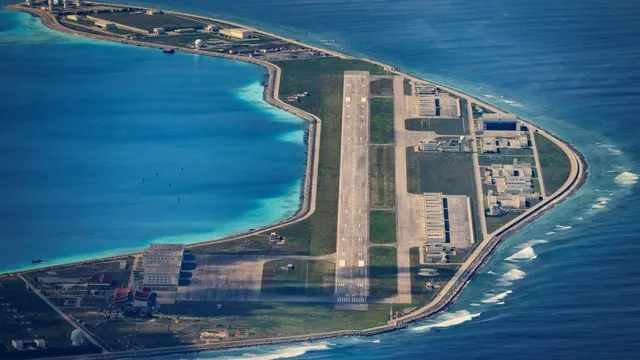
China enhances South China Sea military presence with upgraded facilities
China enhances South China Sea military presence with upgraded facilities
- China has enhanced military infrastructure on its artificial islands in the South China Sea.
- Satellite imagery reveals new facilities for electronic warfare and reconnaissance capabilities.
- These developments could escalate tensions in a region already fraught with territorial disputes.
Story
China has significantly increased its military presence in the South China Sea, particularly through enhancements at its artificial islands in the Spratly Islands. Recent satellite imagery analysis indicates that these outposts have seen new installations that strengthen their intelligence and defensive capabilities. The Asia Maritime Transparency Initiative reported that significant reclamation has occurred since 2015 at key reefs such as Fiery Cross Reef, Mischief Reef, and Subi Reef, with expansions totaling thousands of acres to support military infrastructure. The improved facilities are likely designed for electronic warfare and intelligence operations. The South China Sea is a region marked by contentious territorial claims, with China asserting historic rights that have been ruled against by international law. The United States has responded to China's assertive measures by conducting freedom of navigation operations and patrolling these waters with allies. The new developments on the reefs include radomes and emplacements to host potential weapon systems, suggesting an escalation in military readiness. China's Foreign Ministry has dismissed international rulings regarding its maritime claims, maintaining a defiant stance toward competing claims from neighboring countries. Vietnam has also been engaged in reclamation activities in the Spratly Islands, creating potential for further militarization in the region. Experts believe that China's upgrades are indicative of a strategy to exert control over the electromagnetic spectrum during both peacetime and conflict. The increased military facilities and presence may heighten tensions, attracting scrutiny and counteractions from other countries involved in the disputes. Thus, the developments indicate a consolidation of control by China in the South China Sea, raising concerns over regional stability as diplomatic responses to China's actions remain complex. Both local and international observers are keenly watching to see how other nations will respond to the evolving military landscape and whether this will impact the broader geopolitical situation in the Asia-Pacific region.


