

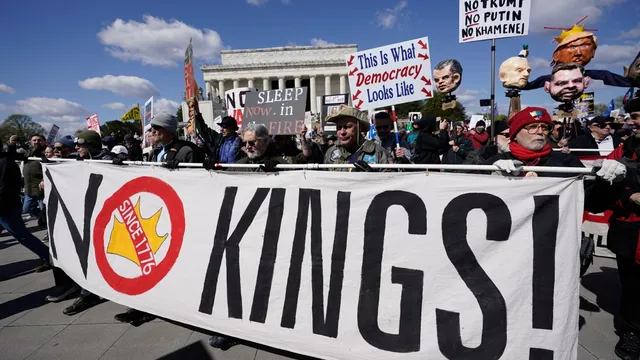
Mary Trump demands action against Trump administration's policies
Mary Trump demands action against Trump administration's policies
- Mary Trump urged citizens to participate in local 'No Kings' protests to resist perceived fascism.
- Over 3,100 events were held across the U.S. and abroad, drawing significant crowds.
- These protests reflect growing public opposition to the Trump administration's domestic and foreign policies.
Story
On March 28, 2026, protests labeled 'No Kings' unfolded across the United States and internationally, in response to the policies of President Donald Trump. Over 3,100 events were scheduled nationwide, with millions anticipated to take part, showcasing a broad discontent with perceived executive overreach and civil rights violations. The flagship rally took place at the Minnesota State Capitol in St. Paul, which garnered over 200,000 attendees, making it a significant focal point for opposition against the administration's controversial actions. Internationally, protests were similarly staged in cities like Paris, Rome, London, and Berlin. At these protests, Mary Trump, the estranged niece of the president, called for public resistance against what she describes as fascism and unchecked power. She emphasized the necessity of citizen participation in defending constitutional rights and democratic values. Alongside her, noteworthy figures such as musician Bruce Springsteen drew attention to the rally in St. Paul, using performance as a means to both inspire and mobilize the crowds. The 'No Kings' protests have historical echoes, stemming from past mass mobilizations against authoritarianism in American history, uniting individuals across various demographics in their discontent. Organizers indicated that the protests were among the most significant single-day demonstrations in contemporary U.S. history, as they extend beyond major cities into less populated regions, indicating a growing grassroots activism in response to the administration's policies. The White House dismissed the events, labeling them as 'Trump Derangement Therapy Sessions,' a term used to minimize the significance of the public demonstrations. However, the turnout reflected a significant public desire for accountability and a call for political action against perceived abuses of power, aiming to channel the protest energy into future civic engagement and electoral processes. The protests on this day will likely have a lasting impact, shaping public discourse as the nation moves forward politically, beyond mere resistance into actionable change.
Context
The history of No Kings protests is characterized by a series of actions and movements that challenge traditional hierarchies and advocate for egalitarian governance. Rooted in a profound desire for social justice, the No Kings protests emerged as a response to perceived oppression and the persistent inequalities perpetuated by monarchical and authoritarian structures. Beginning in the early 21st century, these protests were initially localized but rapidly gained momentum, inspiring similar movements worldwide. Activists rallied not only against monarchical rule but also against political, social, and economic systems that perpetuated disenfranchisement. The protests utilized grassroots organizing, digital platforms, and bold public demonstrations to galvanize support and articulate their message clearly and persuasively. Key moments in the No Kings protests include the significant demonstrations in major cities that exemplified widespread discontent. Protesters employed powerful symbolism, such as the imagery of broken crowns, to signify the rejection of oppressive power structures. Notable events also included community forums and artistic expressions that highlighted the voices of marginalized populations and painted a more comprehensive picture of what a more egalitarian society could look like. These strategic elements not only helped the movement to flourish but also ensured that issues of racial justice, economic disparity, and women's rights were integral to the dialogue surrounding the protests. Media coverage of the No Kings protests played a crucial role in bringing attention to their goals and actions. The digital age facilitated rapid dissemination of information and allowed activists to reach a global audience. Social media platforms became vital for organizing, sharing experiences, and building solidarity across different regions and cultures. The protests were often met with resistance from authorities, resulting in significant confrontations that underscored the urgency of their demands. Nevertheless, the resilience and determination of the movement showcased the powerful impact of collective action in advocating for systemic change. Overall, the No Kings protests signify an important chapter in the ongoing struggle for equity and justice. As these protests evolved, they formed alliances with other global movements that shared similar values. The legacy of the No Kings protests continues to inspire new generations of activists dedicated to creating a world free from oppressive rule, highlighting the need for inclusive governance and the importance of every individual's voice in shaping the future of society. The continued relevance of these protests underscores that the pursuit of equality remains a vital part of political discourse in the modern era.


