

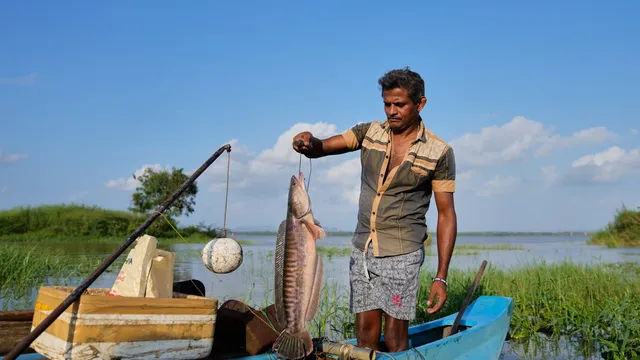
Sri Lankan village seeks to profit from invasive snakehead fish
Sri Lankan village seeks to profit from invasive snakehead fish
- An invasive snakehead fish is threatening the livelihoods of local fishers in Deduru Oya, Sri Lanka, by consuming native fish and shellfish.
- Local fishermen have experienced a significant decline in their traditional catches over the last two years as the snakehead population has grown.
- Fishers are looking to turn the invasion into an economic opportunity through angler tourism and the production of dried snakehead fish.
Story
In a northwestern village of Sri Lanka, local fishers are confronting an invasion of the snakehead fish, an introduced species that has decimated their traditional catch. Over the past two years, the population of native fish and shellfish in the Deduru Oya reservoir has sharply declined, coinciding with the emergence of the snakehead, an aggressive predator previously unknown in the area. Local officials believe that the snakehead originated from ornamental fish that were released into the reservoir by their owners. Dr. Kelum Wijenayake, who has studied the fish, points out that there are no natural predators to control the snakehead’s rapidly growing population, which is thriving in the ideal conditions of the reservoir. Traditional fishers, who began fishing in the reservoir in 2016, now face serious economic challenges due to the depletion of high-value fish such as prawns. Efforts to control the snakehead through angler competitions organized by authorities have so far been ineffective. Despite this, local fishermen are brainstorming ways to utilize the situation to their advantage. Ranjith Kumara, the secretary of the local fishers association, proposes promoting angler tourism as a sustainable method for controlling the snakehead's population while providing new economic opportunities for villagers. Additionally, fisherman Sujeewa Kariyawasam has started producing salted dried snakehead fish, which, while not particularly popular fresh, has gained traction as a flavorful delicacy in dried form. As demand for this product increases, the production could help in managing the invasive fish's spread while providing an alternative income source for the local community.
Context
The invasion of snakehead fish (Channa spp.) poses significant challenges to local fisheries, with detrimental effects on aquatic ecosystems and fish populations. Snakeheads are aggressive predators that compete with native fish for food and habitat, thereby disrupting the established balance within ecosystems. Their ability to adapt to various environments allows them to thrive in diverse habitats, often resulting in rapid population growth, which further exacerbates their impact on native species. As a result, local fishermen are facing declining catches of economically important fish species, leading to reduced income and livelihoods for those reliant on fishing as their primary source of income. In regions where snakehead fish have established populations, there have been documented declines in biodiversity. As these invasive species outcompete and prey on native fish, important trophic interactions are altered. This shift can further ripple through the ecosystem, affecting other wildlife and leading to a potential collapse in local fisheries. Moreover, the reproductive strategies of snakehead fish, which can reproduce multiple times a year and have high fecundity, contribute to their rapid spread and dominance over local fish populations. The economic implications of snakehead fish invasion extend beyond just the fishery sector. Local communities often depend on fishing for food security, cultural practices, and community identity. The decline of local fish stocks can lead to increased dependence on alternative protein sources, which may not be as sustainable or affordable. Furthermore, the necessity for management responses and potential eradication efforts involves substantial financial resources, diverting funds from other critical community needs and possibly causing further economic strain. Mitigation strategies are crucial to managing the impacts of snakehead fish on local fisheries. Effective management plans focus on monitoring populations, enforcement of regulations to prevent further spread, and implementing community awareness programs. Engaging local fishermen in the management processes is essential for developing sustainable fishing practices that can adapt to the changing dynamics caused by snakehead invasions. Collaboration among local communities, government agencies, and environmental organizations is vital for developing and executing comprehensive strategies that address both the ecological and socio-economic challenges posed by the snakehead fish invasion.


