

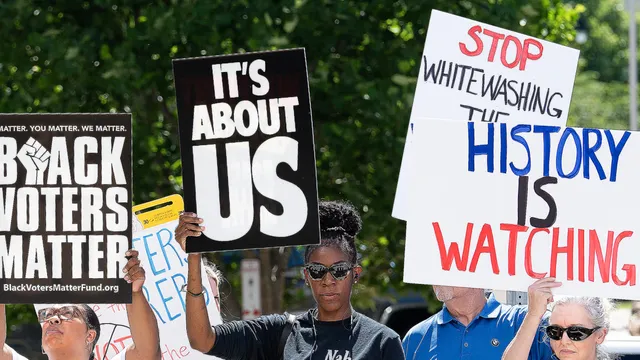
Supreme Court permits Alabama to use discriminatory congressional map
Supreme Court permits Alabama to use discriminatory congressional map
- The Supreme Court's decision allows Alabama to use a new congressional map that eliminates a majority-Black district.
- The ruling was made by a 6-3 majority, with dissent from liberal justices who argued it undermines democratic values.
- This decision is likely to have significant implications for the upcoming midterm elections and the representation of Black voters.
Story
In the United States, the Supreme Court recently permitted Alabama to implement a congressional map that removes one of its two majority-Black districts. This decision, made by a 6-3 majority, came after Republican officials filed an emergency request to use the map, which was enacted in 2023 but had not been utilized. The ruling has been criticized for disregarding the rights of Black voters, as a lower court previously found that the map intentionally discriminated against them, violating the 14th Amendment and the Voting Rights Act. Justice Sonia Sotomayor, in her dissent, argued that the decision undermines democratic values and the rule of law, leading to a chaotic election process. The court's ruling is seen as a significant victory for Republicans, who are attempting to minimize losses in the upcoming midterm elections. The decision also reflects a broader trend among Southern states to redraw electoral maps in ways that dilute the voting power of minority populations, particularly in light of recent Supreme Court rulings that have weakened protections under the Voting Rights Act. The primaries in Alabama, originally scheduled for May 19, were postponed to August 11 to accommodate the changes resulting from the Supreme Court's decision.
Context
The Voting Rights Act of 1965 is a landmark piece of federal legislation in the United States that prohibits racial discrimination in voting. It was enacted to enforce the voting rights guaranteed by the Fourteenth and Fifteenth Amendments to the United States Constitution. The Act was a response to the widespread disenfranchisement of African American voters, particularly in the Southern states, where discriminatory practices such as literacy tests and poll taxes were used to suppress their voting rights. The Act aimed to eliminate these barriers and ensure that all citizens, regardless of race, had the right to vote. Key provisions of the Act included the prohibition of voting discrimination, the requirement for jurisdictions with significant racial discrimination histories to obtain federal approval before changing voting laws, and the establishment of federal oversight in areas with a history of voting discrimination. Over the years, the Voting Rights Act has undergone several amendments and reauthorizations, reflecting the ongoing struggle for voting rights in the United States. The Act was initially set to expire after five years, but it has been reauthorized multiple times, most notably in 1970, 1975, 1982, and 2006. Each reauthorization aimed to strengthen protections against voting discrimination and expand the Act's provisions to address new challenges. However, the Supreme Court's decision in Shelby County v. Holder in 2013 significantly weakened the Act by striking down the formula used to determine which jurisdictions were subject to federal oversight. This ruling effectively nullified the preclearance requirement, leading to concerns about potential voter suppression and discrimination in states that previously required federal approval for changes to their voting laws. In recent years, there have been numerous discussions and legislative efforts aimed at restoring and strengthening the Voting Rights Act in response to the challenges posed by the Shelby County decision. Advocates for voting rights have emphasized the need for new legislation to address modern-day voting discrimination, including measures to combat voter ID laws, gerrymandering, and other practices that disproportionately affect minority voters. The For the People Act and the John Lewis Voting Rights Advancement Act are two significant pieces of legislation introduced in Congress that aim to expand voting access, enhance election security, and restore the protections of the Voting Rights Act. These proposals have garnered significant support from various civil rights organizations and activists who argue that comprehensive reforms are necessary to ensure fair and equitable access to the ballot. As of June 2026, the landscape of voting rights in the United States continues to evolve, with ongoing debates about the balance between election security and access to the ballot. The recent changes in voting laws across various states have raised alarms about potential voter suppression tactics, particularly affecting marginalized communities. The historical context of the Voting Rights Act serves as a reminder of the importance of vigilance in protecting the right to vote. The ongoing efforts to restore and strengthen the Voting Rights Act reflect a commitment to ensuring that all citizens can participate in the democratic process without fear of discrimination or disenfranchisement. The future of voting rights in the United States remains a critical issue, as advocates continue to push for reforms that uphold the principles of equality and justice in the electoral process.


