

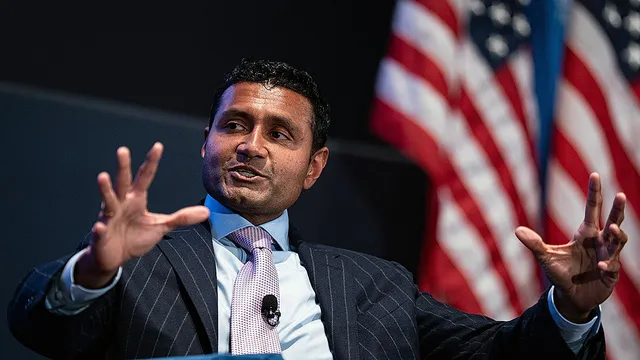
AI drives productivity boom for factory workers and nurses, claims Palantir CTO
AI drives productivity boom for factory workers and nurses, claims Palantir CTO
- Shyam Sankar emphasized the role of AI in enhancing productivity for blue-collar workers, including nurses and factory technicians.
- Concerns about AI causing mass unemployment are challenged by Sankar's assertion that AI creates more job opportunities.
- A call for rethinking education to meet emerging job demands was made, highlighting the need for skilled labor in a tech-driven economy.
Story
In a recent appearance on ‘The Bottom Line’, Shyam Sankar, Chief Technology Officer of Palantir, highlighted the increasingly significant role of artificial intelligence in enhancing productivity among blue-collar workers in manufacturing and healthcare. He contended that AI's benefits extend beyond high-tech sectors, positively impacting frontline workers such as factory technicians and ICU nurses by allowing them to focus more on their core responsibilities rather than administrative tasks. Sankar pointed out that a foreman could now dedicate more time to hands-on work due to AI-driven productivity tools. Sankar's insights challenge the prevailing narrative that fears mass unemployment due to advancements in AI and robotics. He asserted that such claims overlook the transformative potential of AI in creating new opportunities and enhancing existing jobs, especially in sectors that have historically relied on manual labor. He mentioned how companies like Panasonic Energy are likely to evolve their hiring and training practices as they integrate AI into their operations, emphasizing the need for skilled talent in the tech-driven future. Moreover, Sankar called for a more inclusive approach towards AI, urging that a diverse range of stakeholders should participate in shaping its future instead of a few billionaires holding sway over its direction. He expressed concern over the current focus on building extensive data centers, which he views as a misallocation of resources that should instead be directed towards fostering real economic growth and benefiting American workers. By amplifying the conversation around AI's positive impacts, he aims to shift perceptions and understanding of the technology’s potential. Finally, Sankar proposed a rethink of educational systems to better align with future job demands. He believes that colleges must adapt and innovate to prepare students adequately for an economy where AI and technology play critical roles. By creating new pathways for learning and skill acquisition, education can bridge the gap between emerging technologies and the workforce, aligning with the ongoing changes in demand for skilled labor across various sectors.
Context
The impact of Artificial Intelligence (AI) on blue-collar jobs is a multifaceted issue that has garnered significant attention in recent years. As technology continues to advance, automation and AI systems have begun to reshape various industries that rely heavily on manual labor. This report seeks to explore the implications of AI on blue-collar employment, examining both the opportunities and challenges that arise as these technologies become more integrated into the workforce. The concerns associated with AI adoption largely center around potential job displacement, skills mismatches, and the need for reskilling workers to meet the demands of a changing job market. Historically, technological advancements have led to job transformations. The introduction of machinery during the Industrial Revolution, for instance, drastically changed the nature of work for blue-collar laborers. Similarly, AI is expected to alter job roles and responsibilities. While some jobs may become obsolete, AI also creates new job categories that require different skill sets. This presents a dual challenge: workers must adapt to new technologies, and employers need to provide training and development opportunities to facilitate this transition. Many industries, from manufacturing to logistics, are incorporating AI to enhance productivity, improve safety, and reduce operational costs. Consequently, organizations that leverage AI effectively can gain a competitive edge while also creating new roles that did not previously exist. Despite the potential benefits, the reality of job displacement is a significant concern for current and future workers in blue-collar sectors. Certain roles, especially those that involve repetitive tasks, are at greater risk of automation. For instance, jobs in assembly lines, warehousing, and routine maintenance may face significant reductions as AI systems take over these tasks. The displacement effect can lead to economic instability for affected workers, particularly if they do not possess the skills necessary to transition into emerging roles. Research suggests that while some jobs may be eliminated, others will evolve, emphasizing the importance of agility in the workforce and the necessity of continuous education and training. As we look to the future, it is essential for businesses, governments, and educational institutions to collaborate on strategies that address the implications of AI on blue-collar jobs. Initiatives focused on upskilling and reskilling programs can help ensure that workers possess the competencies required for new job opportunities while mitigating the negative impacts of layoffs. Moreover, policies that encourage innovation in job creation and promote inclusive economic growth will be vital in shaping a workforce that can thrive alongside AI technologies. Ultimately, the key to navigating the impact of AI on blue-collar jobs lies in proactive engagement from all stakeholders to foster an adaptable and skilled workforce that can meet the evolving demands of the labor market.


