

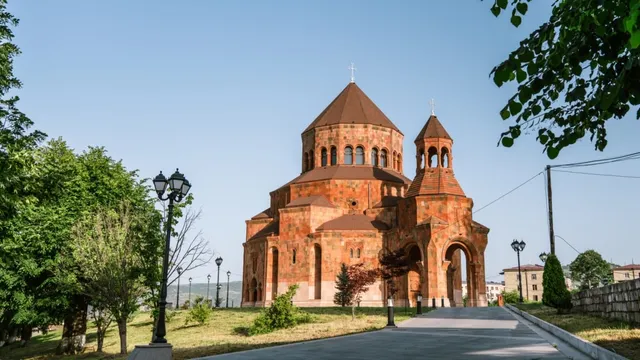
Azerbaijan demolishes significant Christian monuments in Nagorno-Karabakh
Azerbaijan demolishes significant Christian monuments in Nagorno-Karabakh
- In recent weeks, Azerbaijan demolished the Holy Mother of God Cathedral and the Church of St. Jacob in Nagorno-Karabakh.
- The Holy Mother of God Cathedral was constructed between 2006 and 2019, serving as a significant site for the Armenian community.
- The Armenian authorities have accused Azerbaijan of targeting Armenian religious sites to erase their cultural presence.
Story
In recent weeks, Azerbaijan has been confirmed to have demolished two significant Christian monuments in the Nagorno-Karabakh region, namely the Holy Mother of God Cathedral and the Church of St. Jacob. The Holy Mother of God Cathedral, located in Khankendi, known as Stepanakert to Armenians, began construction in 2006 and was consecrated in 2019. It served as the main site for worship for the local Armenian population and had a basement repurposed as a bomb shelter amid ongoing conflicts with Azerbaijani forces. The Church of St. Jacob, completed in 2007 and funded by an Armenian-American philanthropist, also succumbed to the recent wave of destruction. The demolitions occurred in the context of a larger conflict that saw more than 100,000 ethnic Armenians flee the region following Azerbaijan's military offensives, culminating in the full recapture of Nagorno-Karabakh in September 2023. The Armenian authorities have voiced grave concerns regarding these demolitions, with officials accusing Azerbaijan of deliberately targeting Armenian Christian heritage sites in an effort to erase the Armenian presence from the region. The narrative surrounding these demolitions is deeply intertwined with the historical tensions between Armenia and Azerbaijan over Nagorno-Karabakh, a region that had seen de facto Armenian control following the end of the First Nagorno-Karabakh War. On April 23, Armenia's Orthodox Church authorities raised their voices against the destruction, expressing the belief that Azerbaijan was acting with intent to wipe out Armenian Christian history. Meanwhile, an Azerbaijani official claimed their nation preserves religious and historic monuments, insisting that it has no intention of destroying heritage sites. Despite these assertions, evidence suggests that many monuments have been targeted, prompting fears among Armenians about the fate of their cultural heritage. As of recent reports, engagements between Armenian officials and media outlets have revealed a hesitance to escalate the matter to international discussions, meant to navigate the sensitive aftermath of these events with caution. This discretion appears to stem from a wish to avoid provoking further tensions or military actions in the volatile region. The situation continues to evolve, and scrutiny remains on both nations' approaches to heritage preservation versus military strategy as the conflict deepens. These events represent a crucial point in the ongoing struggles for identity and historical legitimacy in a landscape marred by war and ethnic rivalry, illustrating how deeply rooted conflicts over territory can manifest in the destruction of cultural symbols and heritage.
Context
The conflict in Nagorno-Karabakh has deep historical roots and has evolved considerably since its inception in the early 20th century. The region, located within Azerbaijan but predominantly populated by ethnic Armenians, has been a flashpoint for tensions between Armenia and Azerbaijan. After the collapse of the Soviet Union, these underlying tensions boiled over into open conflict, culminating in a war from 1988 to 1994, which resulted in the establishment of the self-proclaimed Republic of Artsakh, backed by Armenia. This conflict led to significant territorial changes, with Armenian forces capturing not only Nagorno-Karabakh but also several surrounding districts of Azerbaijan, creating a complex and lasting animosity between the two nations that remains unresolved today. During the 1990s and early 2000s, despite various ceasefires and attempts at mediation, sporadic violence erupted. The Organization for Security and Co-operation in Europe (OSCE) Minsk Group was established to facilitate dialogue and propose peace options; however, these efforts often faltered due to mutual distrust and nationalism in both countries. The situation further deteriorated in 2016 with increased military skirmishes, highlighting the fragility of the ceasefire and the pervasive militarization of both sides. The international community frequently called for restraint and dialogue but struggled to achieve a lasting resolution. The conflict reignited dramatically in September 2020, leading to a large-scale war that lasted for 44 days and resulted in thousands of casualties. This conflict ended with a ceasefire brokered by Russia in November 2020, which saw Azerbaijan reclaim significant territories that had been occupied by Armenian forces since the 1990s. The ceasefire agreement not only redrew the territorial lines but also brought Russian peacekeepers into the region, highlighting Russia's strategic interests in the South Caucasus. The outcome of the 2020 war significantly shifted the balance of power in the region and raised questions about the future governance of Nagorno-Karabakh and the safety of its Armenian population. The aftermath of the 2020 conflict has seen ongoing tensions, as both Azerbaijan and Armenia attempt to navigate the new geopolitical landscape. On one hand, Azerbaijan aims to solidify its territorial gains and regain control over its internally displaced population, while Armenia grapples with internal political instability and calls for reform following its defeat. Despite ongoing talks within the framework of the Minsk Group and regional diplomacy, the prospect of a sustainable peace remains elusive. The historical grievances and national identities entrenched in the conflict complicate dialogue, with both nations struggling to address the humanitarian concerns of those affected. As of 2026, the future of Nagorno-Karabakh remains uncertain, and a comprehensive resolution to the conflict is still a pressing challenge for both local stakeholders and the international community.


