

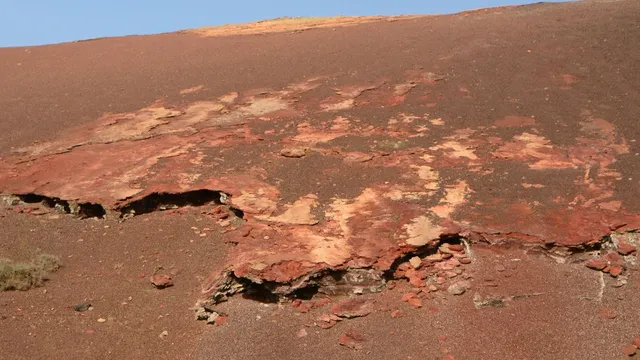
Scientists discover missing chunk of Earth's crust after severe glacial erosion
Scientists discover missing chunk of Earth's crust after severe glacial erosion
- Scientists have identified a missing segment of the Earth's crust linked to severe glacial erosion during the Snowball Earth period.
- The Great Unconformity represents significant gaps in the geological record due to this erosion.
- Estimates suggest that around one billion cubic kilometers of pre-Cambrian material is now considered missing.
Story
In December 2023, scientists revealed significant discoveries regarding the geological history of Earth, specifically focusing on a phenomenon known as The Great Unconformity. This geological irregularity, which has puzzled experts for over a century, refers to large segments of the Earth's crust that are absent from the geological record. Researchers have proposed that this phenomenon can be traced back to severe glacial erosion that occurred during the Snowball Earth period, a time when the planet was nearly entirely covered in ice. It is believed that this erosion led to a drastic gap in the sedimentary record, characterized by a sharp age change of the rock layers, wherein older rocks were lost and subsequently replaced by younger ones. One of the first observations of The Great Unconformity was made in 1869 at the Grand Canyon in Arizona, where researchers noted significant discrepancies in the age of rocks, a trend that was later found to be consistent across several global locations. This led to the establishment of The Great Unconformity as a recognized geological phenomenon. In subsequent studies, including one led by Dr Brenhin Keller from the Berkeley Geochronology Center, it was calculated that an average of 3-5 kilometers of rock were stripped away across various locations, resulting in approximately one billion cubic kilometers (200 million cubic miles) of pre-Cambrian material being classified as missing from expected geological formations. The implications of these findings are profound, as they suggest that there has been more erosion occurring before the Phanerozoic era than scientists previously assumed. This theory is backed by isotopic evidence found in ancient crystals, which exhibit hafnium and oxygen isotopes indicative of erosion from older rock under specific low-temperature conditions. Furthermore, the findings provide insight into the scarcity of asteroid craters older than 700 million years, with most being more recent, possibly linked to this intense period of geological change. Additionally, researchers propose that the same glaciers responsible for eroding sedimentary rocks also contributed to their relocation, washing them out into the oceans. This discovery sheds light on historical geological processes, highlighting a crucial period in Earth's history which may have contributed to the current landscape and geological record found today. Such research enriches our understanding of Earth’s dynamic past and the complex interplay between climate, geology, and the planet's physical evolution.
Context
The Great Unconformity is a significant geological phenomenon characterized by a noticeable gap in the geologic record, where the sedimentary layers abruptly overlie much older rocks. This intriguing feature offers insights into Earth's geological history, revealing periods of erosion, significant geological events, and the complexities of sediment deposition over millions of years. The Great Unconformity is particularly well-exemplified in locations such as the Grand Canyon and various places across North America, where it serves as a striking reminder of the dynamic processes that shape our planet's crust. The discovery and subsequent study of these unconformities have provided geologists with critical information about the planet's formative years and the geological events that led to the current landscape. Scientific investigation into the Great Unconformity has led to a deeper understanding of stratigraphic relationships and the geologic timescale. Unconformities reveal gaps between rock layers, indicating periods of erosion or non-deposition that suggest a turbulent geological history. For instance, the Great Unconformity in the Grand Canyon marks an approximate time span of nearly a billion years between the Vishnu Schist, which is part of the ancient basement rocks, and the overlying Paleozoic sedimentary rocks. This significant time gap challenges geologists to consider what processes may have contributed to these missing geological records and what environmental conditions existed during those time frames. Furthermore, studying the Great Unconformity has implications beyond mere stratigraphy, as it also intersects with the fields of paleontology and ecology. By understanding the periods represented by these gaps, researchers can infer the biological and climatic conditions that prevailed during the time those layers were formed or eroded. The changes in fauna and flora across the geological strata can provide a narrative on evolutionary events and mass extinctions, highlighting how life on Earth has adapted and endured through significant environmental changes. The gradual uncovering of these stories allows for a more holistic understanding of not only the Earth's geological past but also the evolution of its life forms. In conclusion, the Great Unconformity is not just a geological curiosity but a crucial window into the Earth's history, showcasing the interplay between geological processes and life over eons. As geologists continue to learn from these ancient records, they gain valuable insights into the history of our planet. Unconformities like the Great Unconformity challenge researchers to investigate further the complexities of Earth's geological timelines and foster an appreciation for the processes that have shaped our world.


