

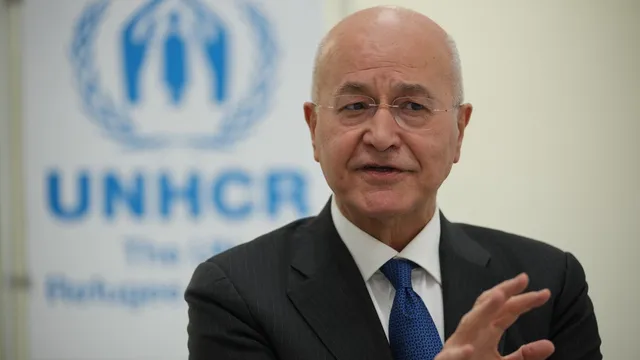
Barham Salih warns of funding crisis for refugees
Barham Salih warns of funding crisis for refugees
- Funding for refugee assistance has dropped significantly, from $2.1 billion to $800 million.
- There are currently 117.3 million forcibly displaced individuals globally.
- Barham Salih is hopeful for a collective humanitarian response amid the crisis.
Story
In early 2026, Barham Salih, the first refugee to lead the U.N. High Commissioner for Refugees (UNHCR), addressed the current challenges faced by refugees globally. He emphasized that the world is undergoing a 'very difficult moment in history,' with rising repression of immigrants and significant declines in funding for their protection. Salih mentioned that the U.S. funding dropped from $2.1 billion to $800 million over a couple of years, which poses a considerable challenge in assisting 30 million refugees worldwide. His tenure began on January 1, and acknowledging the constraints, he expressed hope for a collective humanitarian response to alleviate these pressing issues. Salih’s experience as a refugee shapes his leadership role and commitment to refugees. He fled Iraq for Iran as a young man and subsequently returned to serve as President of Iraq from 2018 to 2022. In his current role, he has already visited refugee camps in Chad hosting those displaced by Sudan’s ongoing civil conflict and in Kenya, where numerous refugees from Somalia, Congo, and Ethiopia reside. His remarks also spoke to the need to adapt to a changing global environment, particularly regarding asylum regulations and humanitarian assistance methods. The article underlines the dire need for nations to re-evaluate their approach to asylum and refugee support amid political shifts, notably those influenced by the Trump administration's policies that have systematically redefined refugee guidelines. There is concern that the 1951 refugee convention, a key protective measure, is under threat. Salih reiterated the moral and legal obligations that governments hold towards both refugees and displaced persons. His agency, UNHCR, currently reports over 117.3 million forcibly displaced individuals and stresses the need for innovative funding strategies to support these vulnerable populations. Salih also highlighted the importance of moral support from influential leaders, such as the Pope, in bolstering the fight for refugee rights. In the face of significantly decreased resources, he insists that it is crucial to prioritize effective assistance delivery, aiming to help refugees become self-sufficient rather than dependent on long-term humanitarian aid. This approach is essential given the stark budget constraints posed by reduced funding in previous years as refugee needs continue to escalate. Despite challenges, Salih remains optimistic about humanity's potential to respond to the refugee crisis compassionately.
Context
The 1951 Refugee Convention, a cornerstone of international refugee law, was adopted on July 28, 1951, and has since become a significant instrument for the protection of refugees. It defines who is a refugee, their rights, and the legal obligations of states to protect them. The core principle enshrined in the Convention is non-refoulement, which prohibits the return of refugees to a country where they face serious threats to their life or freedom. Over the decades, the Convention has been complemented by various treaties and regional frameworks, expanding its reach and adapting to evolving humanitarian needs. As of January 2026, 145 countries are party to the Convention or its 1967 Protocol, illustrating a global commitment to refugee protection despite the varied challenges and crises that continue to arise around the world. In recent years, the status of the 1951 Refugee Convention has come under scrutiny due to increasing forced displacement caused by conflict, persecution, and climate change. The international community has seen record-high numbers of displaced individuals, often leading to new interpretations of what constitutes a refugee and the responsibilities of states to offer asylum. This has resulted in significant pressure on the existing framework and a call for reforms to address contemporary challenges, including burden-sharing among nations, the need for enhanced resettlement programs, and support for host communities. States have also engaged in discussions on adopting a more comprehensive approach to refugee protection, recognizing the interconnections between forced displacement and broader migration issues. Furthermore, the growing number of 'self-declared refugees' and the increase in International Displacement Index challenges existing definitions and the operationalization of the Convention. The COVID-19 pandemic has exacerbated these challenges, with travel restrictions complicating asylum processes and raising concerns about the rights and welfare of refugees. Governments have grappled with balancing public health directives with their obligations under international refugee law, leading to debates over detention practices, access to asylum procedures, and the provision of social services. Efforts to ensure that the Convention adapts to fit the changing landscape of global displacement are crucial and remain a primary concern for both state and non-state actors. In conclusion, while the 1951 Refugee Convention remains a pivotal legal framework for refugee protection, its application in the 21st century faces numerous complexities. It is imperative for states to reaffirm their commitment to uphold its principles while addressing practical challenges. Enhanced political will is necessary to adapt the Convention's provisions to meet the realities of contemporary forced displacement. As discussions around global migration become more relevant, the survival and relevance of the 1951 Refugee Convention will depend on the collective effort of the international community to ensure comprehensive solutions that uphold the dignity and rights of those fleeing persecution.


