

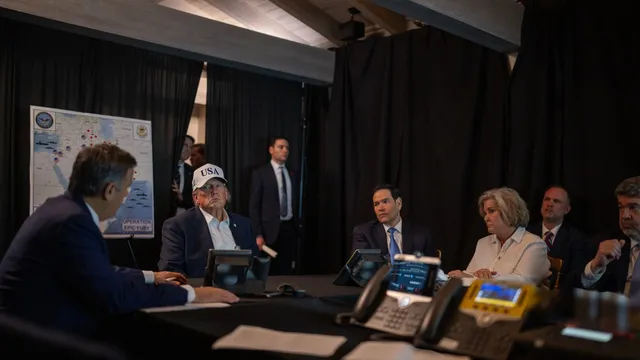
Trump centralizes power in Iran war strategy
Trump centralizes power in Iran war strategy
- Trump has bypassed established military and diplomatic processes, centralizing power in his hands.
- He utilizes aggressive tactics to create leverage and demands urgent actions from international allies.
- The conflict reveals a multifaceted international dynamic, affecting global energy and diplomatic relations.
Story
The ongoing conflict between the United States and Iran has highlighted the unconventional approach taken by President Donald Trump in managing military strategies. This war began amidst heightened tensions surrounding Iran's nuclear program, but it quickly transcended beyond just that issue. Traditionally, military operations would involve extensive planning and collaboration with experts from various agencies; however, recent actions signify a clear departure from that norm. Trump has chosen to exercise unilateral control over the operations, sidelining professional military and diplomatic advice in favor of directives from a small group of advisors. This method raises concerns about the potential risks involved in bypassing established processes. Throughout his career, Trump has consistently utilized confrontational tactics as a means to secure negotiations, often opting for an aggressive opening rather than building trust incrementally. The latest strategies seen in this conflict reflect his broader philosophy of creating leverage through maximalist positions. By invoking immediate threats and demanding urgent actions from allies, he has significantly altered the dynamics of international relations surrounding the situation. This disrupts traditional coalitions, leaving many historical partners feeling excluded or pressured to act against their interests. As such, the implications of Trump's approach extend far beyond just U.S.-Iran relations, affecting global alliances. Another notable characteristic of Trump's strategy is his reliance on constant media attention and disinformation campaigns to manipulate the narrative. Analysts suggest that this tactic serves as a distraction method, ensuring that media outlets and adversaries are continuously reacting to new developments rather than formulating cohesive counter-strategies. This wave of unpredictability keeps other nations off-balance as they attempt to assess the U.S. stance towards Iran and its intentions. It has become evident that the competition in the information domain is a critical aspect of the ongoing conflict. Amid these developments, the geopolitical landscape surrounding Iran is marked by a complex interplay of regional and international interests, with China's involvement particularly noteworthy. As Iran's economy leans heavily on energy exports to China, the stakes have risen for all parties concerned. The dynamics of the Strait of Hormuz have evolved, leading to a shift in how global energy markets are perceived. Despite some media narratives focusing primarily on U.S.-Iran tensions, the broader implications indicate a multifaceted international conflict with lasting repercussions for strategic cooperation and energy security across the globe.
Context
Disinformation has emerged as a potent tool in modern warfare, reshaping the battlefield into a multidimensional space that extends beyond traditional combat. With the rise of digital platforms and social media, disinformation campaigns have become easier to execute and disseminate, allowing for the rapid spread of false narratives that can undermine public trust, manipulate perceptions, and influence political outcomes. These tactics are not limited to state actors; non-state actors and other interest groups have also adopted disinformation strategies to achieve their goals. This evolution highlights the need for robust countermeasures to identify and combat misinformation in contexts that may directly impact national security and social cohesion. At the core of disinformation in modern warfare is its ability to exploit cognitive biases and societal divisions. Campaigns are often tailored to resonate with specific audiences, employing emotional appeals and leveraging existing societal tensions to foment discord. The effectiveness of these campaigns is frequently amplified by algorithms on social media platforms that prioritize engagement over accuracy, allowing misleading information to reach a vast audience with minimal oversight. As misinformation spreads at an unprecedented pace, the strategic implications for governments and militaries are profound, complicating decision-making processes and operational security in conflict zones. Furthermore, the impacts of disinformation are not confined to the battlefield but extend into the realm of strategic communications and international relations. Nations must grapple with the ramifications of foreign disinformation campaigns that can sow distrust among allies and create rifts in alliances. The potential for disinformation to provoke unrest or instability in foreign nations poses a significant risk, prompting some states to develop proactive strategies to counter these threats. The challenge lies in balancing the rapid adaptation required to counter disinformation while preserving freedoms of expression and information. In response to this challenging environment, a holistic approach that encompasses technology, policy, and public awareness is essential. Governments, tech companies, and civil society must collaborate to enhance media literacy, improve fact-checking mechanisms, and develop regulatory frameworks that can efficiently address the dissemination of harmful disinformation. The integration of artificial intelligence and machine learning into these efforts offers promising avenues for identifying and mitigating misinformation without infringing on civil liberties. As disinformation continues to play a critical role in modern warfare, a sustained commitment to understanding and addressing its implications will be necessary to safeguard democratic processes and maintain societal resilience.


