
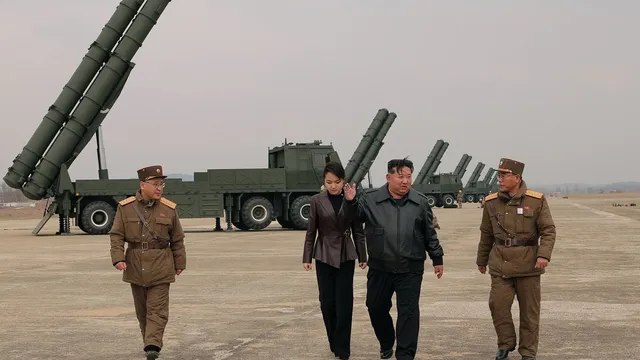
Kim Jong Un showcases military strength with daughter during weapons inspection
- Kim Jong Un and his daughter tested a new-type pistol during an inspection at a military factory.
- The event highlights Kim Ju Ae's increasing visibility in military operations and speculation regarding her future leadership.
- This military display reflects North Korea's ambition to modernize its forces amidst growing tensions with the US and South Korea.
Story
North Korea has been in the spotlight as Kim Jong Un was recently photographed alongside his teenage daughter, Kim Ju Ae, during a military inspection at a munitions factory. The event, heavily covered by North Korean state media, featured Kim praising a new-type pistol, referred to as 'really excellent,' asserting its importance in ramping up the nation's combat capabilities. The photographs depicted both Kim and his daughter in matching black leather jackets, with Kim Ju Ae firing alongside senior military officials, showcasing a calculated push from the dictator to modernize and strengthen conventional military forces. The inspection marked a significant moment, signifying not only engineering advancements within the Korean People's Army but also generating widespread speculation regarding the young girl’s future political role. South Korean intelligence suggests that Kim Ju Ae, around 13 years old, is being groomed as a potential heir. Reports indicate the girl is contributing to policy discussions and is steadily increasing her visibility during high-profile military events, including missile launches and weapons tests alongside her father. This public exposure has been interpreted as part of the regime’s strategy to legitimize her future leadership. Prior to this inspection, the duo had participated in crucial military events, including overseeing the testing of nuclear-capable cruise missiles launched from naval destroyers. As Kim Jong Un strives for an enhanced military presence, reactions from the international community remain mixed, with heightened tensions observed between North Korea, the US, and South Korea. This latest military display coincides with threats issued by Kim's sister, Kim Yo Jong, regarding US-South Korean military drills, emphasizing North Korea's commitment to a robust defense strategy. Analysts outline that Kim Jong Un’s decision to publicly include his daughter in military activities fulfills several purposes. Primarily, it serves to reinforce her image as a capable leader in training, while simultaneously projecting a determined front to external nations observing North Korea's military developments. The two have also been seen extensively during significant events within the regime, including high-profile summits and military parades, reinforcing the narrative of familial leadership continuity in North Korea's deeply entrenched dynastic system. As the uncertainty surrounding regional security dynamics continues, observers remain vigilant, analyzing how Kim's apparent grooming of Ju Ae will influence South Korea's national strategies and relations in the years to come.
Context
North Korea has been engaged in an extensive military modernization program over the past few years, seeking to develop advanced capabilities that will significantly strengthen its military posture. This effort is primarily driven by the regime's perception of external threats, primarily from the United States and South Korea, and a desire to assert its regional influence. The modernization efforts encompass various domains, including missile technology, conventional military forces, and cyber capabilities, reflecting a comprehensive approach to enhancing national defense and deterrent capabilities. A notable aspect of North Korea's military modernization is its focus on missile development. The country has successfully tested a range of ballistic and cruise missiles, including intercontinental ballistic missiles (ICBMs) capable of reaching the U.S. mainland. These tests have demonstrated advancements in missile technology, such as increased range, accuracy, and payload capacity. Moreover, North Korea's pursuit of submarine-launched ballistic missiles (SLBMs) adds a crucial component to its second-strike capability, complicating the security dynamics in the Asia-Pacific region. The regime has also invested heavily in the development of hypersonic glide vehicles, which pose a significant challenge to missile defense systems. In addition to missile capabilities, North Korea is striving to modernize its conventional military forces. The country's armed forces, although historically focused on quantity over quality, are now being equipped with upgraded technology and improved tactics. Efforts include enhancing artillery systems, armor, and the integration of drones into military operations. The regime has also been working on improving logistics and command structures to ensure that its military can operate effectively amid growing complexities in modern warfare. Finally, cyber capabilities have emerged as another critical aspect of North Korea's military modernization. The country has developed sophisticated cyber warfare units that engage in a range of operations, from espionage to disruptive attacks against regional adversaries and global targets. This cyber dimension allows North Korea to project power and influence at a relatively low cost while also supporting its conventional and nuclear forces through intelligence gathering and operational planning. Overall, North Korea's military modernization efforts reflect a determined strategy to bolster its defense posture, project strength regionally, and leverage advanced technologies to complicate the security landscape for its adversaries.
