

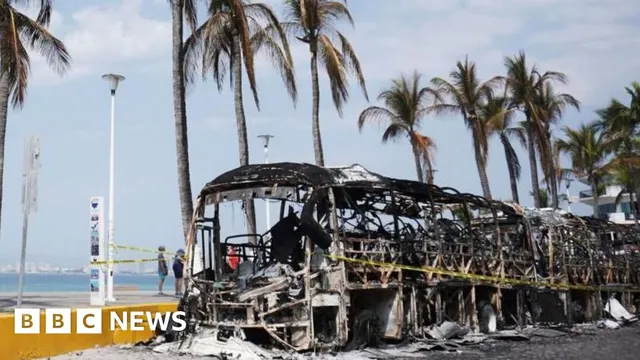
Guadalajara faces chaos after cartel leader's death
Guadalajara faces chaos after cartel leader's death
- The death of cartel leader Nemesio El Mencho Oseguera led to violent chaos in Guadalajara.
- Residents faced severe disruptions with businesses closed and public transportation suspended.
- Concerns about ongoing violence cast doubt on the city's ability to safely host the upcoming FIFA World Cup.
Story
In Jalisco, Mexico, the killing of Nemesio El Mencho Oseguera, leader of the Jalisco New Generation Cartel (CJNG), sparked a violent response that left Guadalajara in chaos. The incident led to an outbreak of violence as cartel members retaliated, resulting in burnt vehicles littering the streets and significant fear among residents. The atmosphere within the city turned grim as most businesses shuttered, schools remained closed, and public transport was suspended. Families were advised to stay home while many waited for essential supplies, reflecting the tense situation. The atmosphere in Guadalajara was reminiscent of a pandemic lockdown, with long lines forming outside the few businesses that remained open. People needed food and basic supplies but faced hours of waiting due to the violence. Many found themselves stranded without access to transportation. Reports indicated that more than 1,000 individuals were trapped within the city’s zoo and unable to return home for extended periods. The entire city faced restrictions and barriers due to the escalating violence from the cartels. By a few days later, the situation had stabilized somewhat, but lingering fears persisted among residents who still bore the scars of the violence. Posters depicting missing individuals lined the streets, representing a deeper issue of disappearances associated with cartel activity, a tragedy that affected thousands in Jalisco alone. The Mexican government attempted to reassure both locals and international visitors, especially with the upcoming FIFA World Cup set to take place in Guadalajara. Despite the assurances from authorities, concerns about safety during the World Cup remained high, as locals expressed doubt about the government's ability to maintain order amidst the turmoil of cartel violence. A local parliamentary deputy criticized the ongoing cycle of violence perpetuated by a longstanding government strategy focused on eliminating cartel leaders rather than addressing the socio-economic factors that contribute to cartel membership. As the city attempted to return to normal, the community continued to brace for potential further violence arising from the power vacuum left by El Mencho’s death.
Context
The current situation in Mexico regarding drug cartel violence remains a critical concern for both national and international security. Over recent years, the rise of powerful drug trafficking organizations has resulted in escalating levels of violence, often characterized by brutal clashes between rival cartels and confrontations with law enforcement. As of February 2026, the presence of these organizations continues to destabilize various regions of Mexico, with states such as Guerrero, Jalisco, and Michoacán being particularly affected by ongoing conflicts. The strategies employed by these cartels have evolved, increasingly involving not just drug trade but also extortion, human trafficking, and arms smuggling, further complicating the landscape of crime in the country. The toll on civilians, with countless deaths and disappearances, alongside the socioeconomic implications of this violence, paint a grim picture of the reality faced by many in affected areas. Governmental efforts to combat this endemic violence have seen varying degrees of success. Initiatives aimed at reforming law enforcement, increasing military involvement, and implementing social programs intended to reduce poverty and improve education have all been part of a multi-faceted approach. However, challenges remain, as corruption within law enforcement agencies undermines these efforts. Moreover, the militarization of the response to cartel violence has led to accusations of human rights abuses, raising questions about the ethical implications of such measures. The need for a balanced approach that incorporates both security and community development is increasingly being recognized by policymakers. International cooperation has also played a role in addressing the issue, with countries like the United States offering assistance through programs aimed at enhancing Mexico's law enforcement capabilities. This collaboration is crucial, given the cross-border nature of drug trafficking operations that supply a significant portion of narcotics to markets in the U.S. and beyond. Efforts to tackle the financial networks that support these cartels and disrupt their supply chains have gained momentum, highlighting a more strategic approach to undermining their operations. Nonetheless, the challenge persists as cartel leaders adapt and find new avenues for drug distribution amidst intensified scrutiny. In conclusion, the ongoing violence perpetrated by Mexico's drug cartels poses a severe threat not only to domestic stability but also to regional and global security. The complex interplay between criminality, poverty, and governance necessitates a comprehensive strategy that addresses both immediate security concerns and the underlying social issues that fuel this cycle of violence. Moving forward, it will be critical for the Mexican government and its partners to adopt innovative and collaborative solutions in order to foster long-term peace and security in affected regions.


