

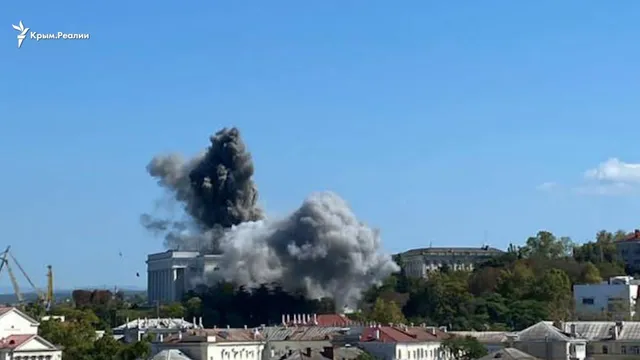
Russian Black Sea Fleet's command center obliterated by missile attack
Russian Black Sea Fleet's command center obliterated by missile attack
- The headquarters, a historic symbol of Russian naval presence, was targeted and struck by a missile in September 2023.
- Following the successful strike, the Russian command structure relocated due to the loss of infrastructure and naval capabilities.
- The destruction signifies the Ukrainian military's strategic gains and the declining fortunes of the Russian Navy.
Story
In Ukraine, the destruction of the Black Sea Fleet headquarters was a significant event that marked a shift in naval power dynamics. The building, originally designed in 1900 and located in the Crimean Peninsula port city of Sevastopol, had a storied history. It served various purposes over the years, including as a naval entertainment hall post-1917 Bolshevik Revolution, and then was rebuilt by the Soviet Union after being damaged in World War II. After the Soviet collapse and Ukraine's independence, Russia maintained control of its naval headquarters while Crimea was administered by Ukraine. In 2014, Russia seized Crimea, claiming the facility and many of Ukraine's naval assets. The port became a strategic base for Russian forces during the invasion of Ukraine that began in February 2022. A notable incident occurred on April 14, 2022, when Ukrainian forces sank the flagship of the Russian Black Sea Fleet. Following this, Ukraine commenced a campaign to weaken Russia's naval capabilities by employing various missile systems. On September 13, 2023, Ukraine targeted repair facilities in Sevastopol, signaling an escalation in military operations. Subsequently, on September 22, 2023, a missile attacked the headquarters itself, identified as a British-supplied Storm Shadow missile. Reports suggested that several high-ranking Russian officers may have been killed, although confirmation was pending. The attack further underscored the efficacy of Ukraine's military strategy in dismantling Russian naval prowess. Subsequent to the missile strike, the headquarters was deemed unusable, and reports indicate that the Russian naval command relocated to Novorossiisk, as their presence in Sevastopol had diminished to essentially only damaged vessels. The building's grand history ended when it was officially removed from Russia's cultural heritage list in December 2025 following complete destruction, reinforcing the symbolic loss for Russia amidst the ongoing conflict.
Context
Sevastopol, a city located on the Crimean Peninsula, has played a pivotal role in various historical conflicts, most notably during the Crimean War of the mid-19th century and more recently during the geopolitical tensions arising from the annexation of Crimea by Russia in 2014. Its strategic position along the Black Sea has made it a significant naval base and holding ground for various empires, including the Russian Empire, the Soviet Union, and now the Russian Federation. The importance of Sevastopol is underscored by its access to vital maritime routes, which has historically allowed control over naval operations in the Black Sea and the Mediterranean Sea, rendering it a focal point for regional military power dynamics. In the context of the Crimean War (1853-1856), Sevastopol became notorious for the protracted siege it endured from the British and French forces, which aimed to contain Russian expansion. The city was a symbol of Russian resilience as its defenders withstood substantial adversity. The Siege of Sevastopol demonstrated the impact of industrial advancements on warfare, with modern artillery and trench warfare tactics employed, thereby influencing future military strategies globally. The war also resulted in significant political reshuffling in Europe, reducing Russian influence while highlighting the collaborative efforts of Britain and France, which had implications for European diplomacy. Fast forward to the early 21st century, Sevastopol once again witnessed heightened military significance during the 2014 crisis in Ukraine. Following Ukraine's political upheaval, Russia annexed Crimea, with Sevastopol serving as a crucial point of interest given its naval installations and military capabilities. This move was widely condemned by the international community, leading to sanctions against Russia and diplomatic disputes involving NATO countries. The annexation has since resulted in heightened tensions in Eastern Europe, impacting relationships between Russia and the West and altering security paradigms in the region. Sevastopol remains a contested symbol of national pride for Russia and a point of contention internationally. Its historical significance is not just in its military past but also in the ongoing ramifications of its status and the geopolitical implications it carries. As global dynamics shift, the focus on Sevastopol reveals the intertwining of historical legacy and contemporary political realities, emphasizing the importance of understanding this strategic location as both a military asset and a barometer for regional stability.


