

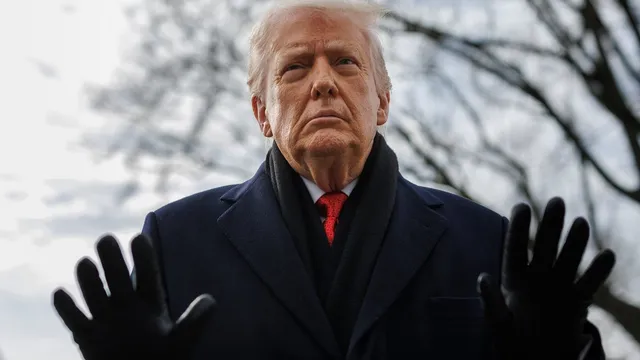
Trump drops tariff threats after Greenland deal discussions
Trump drops tariff threats after Greenland deal discussions
- Trump announced he would not impose tariffs on European countries opposing his Greenland acquisition plan.
- This announcement led to a significant upturn in global stock markets, reflecting reduced trade tensions.
- The diplomatic shift signals a victory for European allies concerned about Denmark's sovereignty.
Story
In January 2026, Donald Trump announced that he would not impose tariffs on eight European countries, including the UK, which had opposed his push to acquire Greenland. This shift in stance followed discussions with NATO Secretary-General Mark Rutte regarding a proposed framework for cooperation in Greenland. The announcement generated a positive reaction in global stock markets, as investors welcomed the reduced trade tensions. Stocks in Europe experienced significant gains, with indices such as the FTSE 100, Dax, and CAC 40 rising notably on the day Trump made his announcement. Trump's previous threats had created uncertainty in financial markets, leading to a turbulent week for global investments. Following this backtracking, experts observed a relief rally across stock markets in Europe, reflected by a 0.8% rise in the FTSE 100 and larger gains in German and French markets. The previous tensions had been attributed to Trump's ambition to exert more influence over Arctic security, primarily aimed at countering Russian and Chinese influence in the region. Analysts indicated that the outcome signified a diplomatic victory for European countries advocating for Denmark's sovereignty over Greenland. Despite the positive developments, some observers voiced skepticism regarding the actual implementation of any proposed agreements. They noted that serious diplomatic negotiations would be necessary to ensure the framework was respected and progressed beyond verbal commitments.
Context
The imposition of tariffs among NATO countries has significant implications for economic relations, trade dynamics, and geopolitical stability within the alliance. Tariffs, as tools for protecting domestic industries from foreign competition, can lead to increased prices for consumers and the inefficiencies of resource allocation. As NATO countries strive to maintain unity in defense and collaborative strategies, the economic repercussions of tariffs can create rifts among member states. Historically, tariffs have prompted retaliatory measures, which can escalate into trade wars, causing further strain on international relations and collective defense commitments. The interdependence of NATO economies means that tariffs can have a ripple effect, influencing various sectors across borders, including technology, manufacturing, and agriculture. Members heavily reliant on exports to one another may face reduced market access, leading to economic backlash and reduced cooperation in other areas of policy and military engagement. In addition to economic consequences, tariffs also have political dimensions that can affect NATO's strategic posture. The perception of unfair trade practices can lead to increased nationalism and protectionist sentiments within member states, challenging the foundational principle of collective security. Countries may prioritize domestic industry over NATO commitments, which could hinder long-term military strategies and interoperability among armed forces. Furthermore, tensions arising from tariff disputes can undermine collaborative initiatives and complicate negotiations related to joint military operations or defense spending obligations among members. The potential for discord places additional pressure on NATO's political cohesion and questions the alliance's efficacy in addressing security threats globally. The evolving geopolitical landscape, particularly the rise of non-NATO adversaries, demands that member states prioritize cooperation over competition. With the burgeoning influence of countries like China and Russia, NATO must present a unified front in both military and economic arenas. Tariffs among member countries could embolden adversaries by showcasing vulnerabilities in the alliance's unity. Thus, it is crucial for NATO leaders to engage in constructive dialogue concerning trade policies and to explore alternatives to unilateral tariff imposition, such as negotiation and mutual agreements to lower trade barriers, which would benefit security and commercial interests alike. Ultimately, while tariffs are employed as a means to protect national economies, their long-term impact on NATO’s cohesion and operational integrity cannot be overlooked. The alliance must navigate the complexities of trade relations with a keen awareness of their implications for both economic stability and geopolitical security. Prioritizing collaboration, transparency, and consensus-building will be essential for NATO member states in promoting not only economic resilience but also maintaining the collective defense imperative that underpins the alliance. As global markets continue to evolve, the challenge remains for member nations to balance national interests with the overarching goal of strengthening NATO solidarity.


