

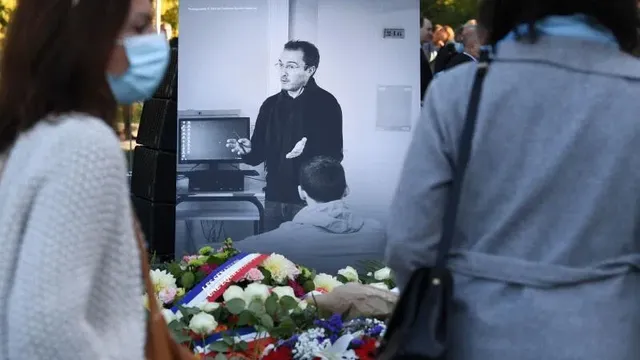
French court reduces sentences for accomplices in Samuel Paty beheading case
French court reduces sentences for accomplices in Samuel Paty beheading case
- On March 2, 2026, a French court reduced the jail sentences of three accomplices in the 2020 beheading of teacher Samuel Paty.
- The reductions were based on their involvement in aiding the attacker and spreading false claims about the teacher.
- The court's decisions emphasize the ongoing tension in France regarding freedom of expression and the consequences of inciting violence.
Story
In 2024, a French court upheld sentences for a group of individuals linked to the beheading of Samuel Paty in Conflans-Sainte-Honorine, which occurred in 2020. The court's decision was delivered on March 2, 2026, reducing the sentences for three men involved in the crime. Abdoullakh Anzorov attacked Paty, motivated by false claims circulated by Brahim Chnina, who falsely accused Paty of pressuring Muslim students to leave his classroom. Consequently, the court found Brahim Chnina and others guilty of fostering hate, which culminated in the tragedy. The case revealed deeper tensions surrounding freedom of expression in France, particularly as it involved content viewed as blasphemous by some communities. The implications of the case became evident in broader discussions about the responsibility of individuals in inciting violence and the judiciary's role in addressing severe acts against freedoms such as speech and belief. The decisions made by the court also prompted a significant public response, highlighting the contentious nature of such cases as they touch upon deeply held beliefs and societal values within secular and multicultural frameworks. Ultimately, the proceedings underscored the ongoing challenges France faces in balancing freedom of expression against feelings of communal insult, a struggle reflecting wider global tensions amidst differing cultural understandings and the interpretation of rights.
Context
The case of Samuel Paty, a French teacher assassinated in October 2020, profoundly impacted French society and sparked nationwide debates on freedom of expression, secularism, and the integration of immigrant communities. The gruesome murder, in response to Paty's use of caricatures of the Prophet Muhammad in class, ignited conversations about the boundaries of free speech and the responsibilities of educators in a multicultural society. The outpouring of grief and outrage led to widespread demonstrations across France, with citizens rallying to defend the principles of liberty, equality, and fraternity, which are cornerstones of the French Republic. In the wake of Paty's death, discussions around secularism intensified, emphasizing the need to uphold republican values in the face of extremism and intolerance. The national response included a series of measures aimed at combating radicalism and reinforcing secularism within schools. The French government implemented policies to ensure that educators are equipped to handle sensitive topics related to religion and free speech, leading to increased training on secularism and cultural awareness within the education system. Furthermore, schools were encouraged to foster an environment of dialogue and respect among students of diverse backgrounds, highlighting the importance of understanding different perspectives without compromising on civic values. This shift reflects a broader societal realization that education is not only about imparting knowledge but also about cultivating critical thinking and respect for democratic principles. Additionally, the Samuel Paty case has had a profound impact on the discourse surrounding immigration and integration in France. Many citizens and political leaders have called for a reevaluation of how immigrant communities are integrated into French society, with a focus on promoting shared values and responsibilities. The incident reignited fears of radicalization among certain segments of the population, leading to debates about the effectiveness of current integration policies. Some groups argue that a more aggressive stance is necessary to combat extremism, while others caution against nurturing an atmosphere of division and suspicion. This complex dialogue reflects the ongoing struggle within France to balance multiculturalism with national identity and social cohesion. In conclusion, the impact of the Samuel Paty case continues to resonate throughout French society, prompting discussions on free speech, secularism, and national integration. The events surrounding his assassination have catalyzed a reevaluation of educational practices, government policies, and societal attitudes towards diversity and extremism. Moving forward, it is imperative for France to engage in constructive dialogue that honors Samuel Paty's legacy while fostering a society where diverse beliefs can coexist within the framework of republican values. As the nation grapples with the implications of this tragedy, it is essential to remain vigilant against hatred and division while reinforcing a commitment to the principles of liberty and equality for all.


