

Trump defends Saudi crown prince over Khashoggi murder questions
Trump defends Saudi crown prince over Khashoggi murder questions
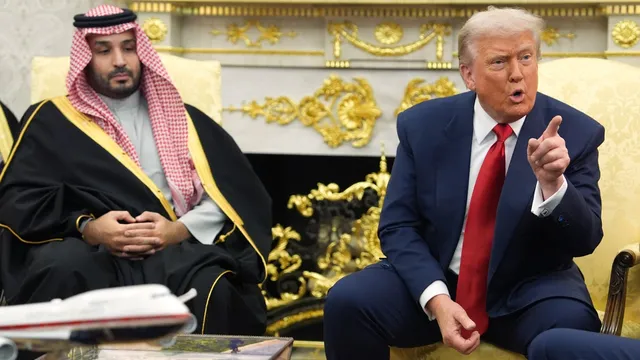
- President Trump hosted Crown Prince Mohammed bin Salman at the White House, which marked his first visit since the 2018 murder of journalist Jamal Khashoggi.
- During the meeting, Trump dismissed questions about the crown prince's involvement in Khashoggi's death and asserted that Khashoggi was a controversial figure.
- The event demonstrated the U.S.'s complicated diplomatic relationship with Saudi Arabia, especially in light of ongoing human rights concerns.
Story
In 2025, President Donald Trump welcomed Saudi Crown Prince Mohammed bin Salman to the White House for the first time since the 2018 murder of journalist Jamal Khashoggi, who was killed by Saudi agents. Trump reacted angrily to a reporter's inquiry about the crown prince's alleged involvement in the murder, labeling the question as inappropriate and expressing confidence in bin Salman's innocence. He emphasized that Khashoggi was a controversial figure and claimed that many people disliked him. The president also defended his family business ties to Saudi Arabia, insisting he had no personal involvement in them. The meeting, which coincided with discussions on investment and military sales, marked a significant diplomatic gesture given the historical context of Khashoggi's assassination and the subsequent scrutiny of Saudi relations with the U.S. in light of intelligence assessments. Throughout this period, the U.S. government has faced challenges in addressing human rights concerns while seeking to maintain strong diplomatic and economic ties with Saudi Arabia. The event illustrated the complex dynamic between fostering alliances and responding to pressing human rights issues, raising questions domestically and internationally about the U.S. approach to such relationships, especially with a country proactively pursuing regional influence and reforming its global image.
Context
The impact of Saudi-US relations post Khashoggi has been profound, marking a significant shift in diplomatic engagement, economic ties, and strategic alliances. The murder of journalist Jamal Khashoggi in October 2018 created a rift in the relationship between Saudi Arabia and the United States, leading to widespread international condemnation of the Saudi crown prince, Mohammed bin Salman. The incident raised serious questions regarding human rights practices in Saudi Arabia and the implications of powerful alliances prioritizing stability and economic interests over human rights. The ensuing fallout saw U.S. lawmakers pushing for sanctions against Saudi officials, signaling a turning point in how the U.S. administration engaged with Riyadh, even as economic interdependence remained a significant aspect of the relationship. Following Khashoggi's death, the U.S. took cautious steps in recalibrating its approach to Saudi Arabia. While the Trump administration faced criticism for continuing arms sales and maintaining strong bilateral ties, the Biden administration adopted a different stance, emphasizing the need to reassess America's role in the region. This led to a more overt focus on human rights in U.S. policy and the re-evaluation of military support for operations in Yemen. Moreover, the Biden administration's willingness to confront Saudi Arabia on its human rights record reflected a broader strategy of seeking to balance American interests in security and defense with increasing pressure for reform in the kingdom. Economically, the kingdom continued to play a crucial role in global oil markets, which kept it strategically relevant to the U.S. However, the event catalyzed efforts within the Saudi leadership to diversify the economy through initiatives like Vision 2030, aiming to reduce reliance on oil. Despite these efforts, the relationship became tangled in the complexities of rising geopolitical tensions, especially with Iran and the ongoing conflicts in the region. As a result, U.S. sanctions and denunciations often conflicted with financial and security needs, illustrating the precarious balance that both nations sought to maintain. Overall, the legacy of Khashoggi's murder has left an indelible mark on Saudi-U.S. relations, leading to heightened scrutiny of political and economic ties while also prompting defensive responses from the Saudi leadership. Despite ongoing criticism and moral obligations put forth by the U.S. government, both countries continue to navigate this complex relationship, balancing economic interests with the moral imperatives established as a result of Khashoggi's tragic death. The implications for future diplomatic engagement will be significant as both nations adapt to changing political landscapes and domestic pressures.


