

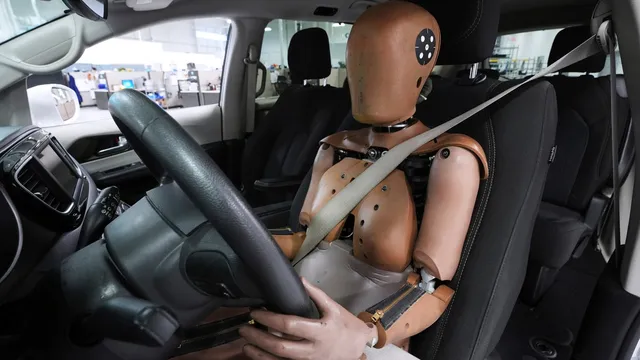
US government endorses female crash test dummy to improve car safety for women
US government endorses female crash test dummy to improve car safety for women
- Women face a higher risk of injuries and fatalities in car crashes, with research indicating 73% higher injury rates in head-on collisions compared to men.
- The new female crash test dummy design is intended to reflect anatomical differences and enhance accuracy in safety testing.
- The endorsement of the female crash test dummy has garnered bipartisan support, aiming to improve automotive safety standards.
Story
In a significant turn of events for automotive safety, the U.S. government has recently endorsed a new design for a female crash test dummy. This announcement responds to alarming statistics indicating that women are more likely to suffer injuries or fatalities in car crashes compared to men, with women being 73% more likely to be injured in head-on collisions and 17% more likely to die in accidents. Historically, the standard crash test dummy, created in 1978, was modeled after a 5-foot-9, 171-pound man, which has contributed to safety gaps that fail to account for the differences between male and female anatomy. The newly designed dummy is smaller and features modifications, including a rubber jacket to mimic breasts, allowing for more accurate testing relevant to female drivers. The Department of Transportation aims to incorporate this dummy into government vehicle crash tests. It comes equipped with over 150 sensors, enhancing the precision of injury assessment during tests, particularly in driver and passenger seats where female drivers are often underrepresented in research and testing protocols. Despite the potential advancements in safety, several American automakers have voiced skepticism regarding the new dummy. They argue that it might exaggerate injury risks and undermine the efficacy of existing safety features such as airbags and seat belts. This concern raises an important dialogue within the automotive industry about the balance between improving safety standards and adequately addressing real-world outcomes from vehicle crashes. Legislative support for the incorporation of female crash test dummies into safety regulations has seen backing from prominent figures, including U.S. Senators Deb Fischer and Tammy Duckworth. Both senators stress the importance of updating testing standards, with Fischer introducing the She Drives Act, which mandates the inclusion of advanced testing devices, including the female crash test dummy. Without significant progress on these fronts, the ongoing disparity in injury rates for women in car crashes is expected to persist, prompting urgent calls for reform in testing standards to achieve equitable safety in vehicles for all drivers.
Context
The history of crash test dummies dates back several decades, emerging from the need to enhance vehicle safety and minimize injury risk in automobile crashes. The development of these anthropomorphic test devices is closely linked to advancements in safety research and crash testing methodologies that began gaining momentum in the mid-20th century. Initially, researchers sought ways to simulate human body dynamics during automobile collisions. In the 1940s and 1950s, early versions of crash test dummies were created, but they were rudimentary and lacked the sophisticated instrumentation found in today's models. Early tests primarily utilized simple models and anthropometric approximations to provide basic insights into collision impacts. However, the limitations of these basic models soon became apparent, as they could not accurately replicate human responses to the wide range of forces encountered in vehicle accidents. By the 1960s, as automobile ownership surged and traffic fatalities increased, the need for improved crash safety standards prompted significant advancements in dummy design and testing processes. This period saw the introduction of the first full-scale crash test dummies, such as the Hybrid III, which featured more accurate physical representations of human anatomy, enabling researchers to gather more reliable data. These dummies incorporated sensors to measure forces and accelerations at various points of the body, providing critical information that would influence automotive design and regulatory compliance. The reliability and accuracy of these dummies transformed the landscape of automotive safety testing, allowing engineers to assess and improve vehicle structures, seatbelt systems, and airbag deployments effectively. As researchers continued to enhance the realism of crash test dummies, the development of child dummies emerged in response to concerns over child safety in vehicles. By the late 20th century, a range of dummies representing different ages, weights, and body types had been developed, allowing for comprehensive studies of crash impacts on passengers of different sizes. This expansion broadened the scope of automobile safety research and prompted changes to regulations and standards aimed at protecting all occupants, especially vulnerable populations like children and the elderly. Furthermore, the 21st century witnessed the introduction of advanced dummy models integrated with sophisticated technologies, such as wireless data transmission and real-time monitoring capabilities, enabling researchers to gather more precise data during tests. Today, crash test dummies are invaluable tools in the ongoing quest for improved vehicle safety. Their evolution reflects not only technological advancements but also a growing societal emphasis on comprehensive crash safety awareness. The efforts to refine the design and instrumentation of crash test dummies have largely influenced advancements in automotive safety engineering, leading to the development of safer vehicles and helping to reduce fatalities and injuries on the roads. As ongoing research continues to explore the human body's responses to vehicle impacts, the history of crash test dummies will remain a testament to the intersection of innovation, safety, and human factors.


