

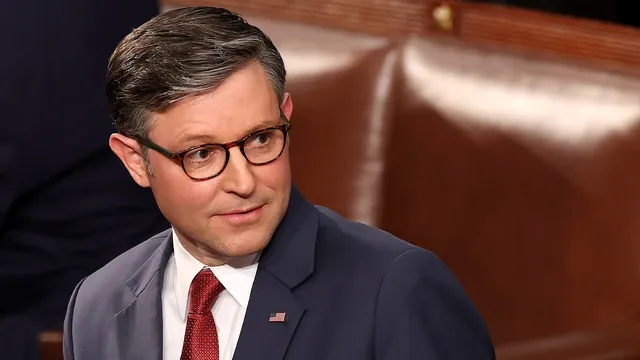
Mike Johnson insists on rejecting antisemitism amid GOP divisions on Israel support
Mike Johnson insists on rejecting antisemitism amid GOP divisions on Israel support
- House Speaker Mike Johnson describes the U.S.-Israel alliance as crucial for American strategic interests.
- He warns against rising antisemitism and calls for a united rejection of it.
- Johnson's comments reflect a division within the Republican Party regarding Israel, emphasizing the need for a consensus on this critical relationship.
Story
In a recent interview on "The Katie Miller Podcast," House Speaker Mike Johnson defended the significance of the U.S.-Israel alliance, emphasizing its strategic necessity for the United States. He highlighted the ongoing divisions within the Republican Party regarding support for Israel, suggesting that it's critical for all members to recognize the importance of this relationship. Johnson characterized Israel as the only stable democracy in a volatile Middle East, underscoring its value not only from a biblical perspective but also from a strategic national interest standpoint. Additionally, he strongly denounced rising antisemitism, asserting that it should be rejected across the board, and expressed a commitment to love and support the Jewish people.
Context
The history of the U.S.-Israel alliance dates back to the founding of the state of Israel in 1948, shortly after which the United States became one of the first countries to recognize Israel. This recognition was part of a broader U.S. strategy to assert influence in the Middle East during the Cold War, while also aligning with democratic and pro-Western governments. Over the years, the relationship strengthened based on shared values of democracy, anti-communism during the Cold War, and mutual strategic interests. The alliance grew in depth through military and economic support, notably with programs developed during the 1970s and 1980s, which enabled Israel to become a key military ally and a bastion of Western influence in a predominantly Arab region. This partnership was characterized by the sharing of intelligence, military hardware, and joint training exercises which laid the groundwork for Israel's defense capabilities and regional posture. Significantly, the 1967 Six-Day War marked a pivotal moment in U.S.-Israel relations, showcasing Israel's military capabilities and leading to increased American support. The aftermath of the war highlighted the importance of Israel as a strategic ally in a volatile region. In the ensuing decades, U.S. military aid to Israel increased substantially, culminating in the signing of multiple agreements, including the 2007 Memorandum of Understanding, which solidified long-term military and economic assistance. Additionally, the U.S. served as a diplomatic backstop for Israel on various occasions in international forums such as the United Nations, often leveraging its veto power in the Security Council to protect Israeli interests. The alliance has evolved to encompass not just military and strategic ties, but also extensive cooperation in areas of science, technology, and trade. Innovations in security technology, cybersecurity, and agriculture, among others, have seen strong collaboration between American and Israeli firms, yielding significant advancements beneficial to both economies. The relationship has also fostered extensive cultural and academic exchanges, further knitting the two nations together. This multifaceted partnership has served both nations over time, providing Israel with security assurances and the U.S. with a reliable ally in the Middle East, critical for its geopolitical strategies, especially in countering Iranian influence and addressing terrorism. In recent years, the alliance has been tested by various geopolitical shifts, including changing administrations in the U.S. and developments within Israel. Issues such as the Israeli-Palestinian conflict and the Iranian nuclear program continue to challenge the alliance's dynamics. Nevertheless, the fundamental underpinnings of the U.S.-Israel relationship—shared democratic values, mutual strategic interests, and strong people-to-people ties—remain resilient. As the global geopolitical landscape continues to evolve, the U.S.-Israel alliance is likely to adapt while maintaining its core significance in both nations' foreign policy agendas.


