

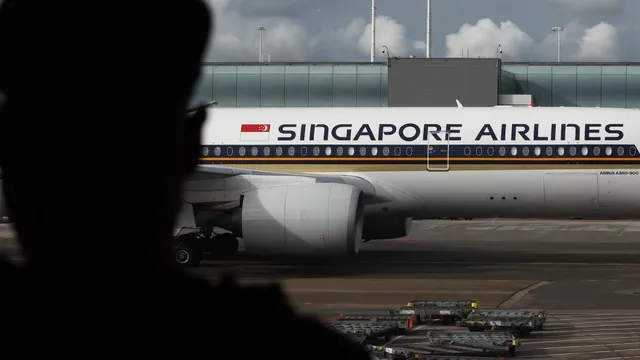
Singapore Airlines faces steep losses from Air India investment
Singapore Airlines faces steep losses from Air India investment
- Singapore Airlines reported a 57.4% drop in net income for FY2025, amounting to $927 million.
- The airline incurred significant losses from its investment in Air India, totaling 945 million Singapore dollars.
- Despite challenges, Singapore Airlines aims to transform Air India into a world-class carrier.
Story
In Singapore, Singapore Airlines (SIA) reported a significant financial downturn for the fiscal year ending March 2025, which translated to a net income drop of 57.4% to 1.2 billion Singapore dollars, equivalent to around 927 million US dollars. The report, issued recently, indicated that a considerable factor contributing to this decline is the airline's investment in Air India, which resulted in a loss amounting to 945 million Singapore dollars, or approximately 739 million US dollars. This investment had long been seen as a strategic initiative for SIA amid increasing opportunities in the Indian aviation market. The challenges faced by Air India, now under Tata Sons' management following the acquisition of the state-owned airline in 2022, have compounded issues for SIA. In the wake of the AI171 crash that resulted in 260 fatalities, Air India experienced record losses of 2.8 billion dollars for the same fiscal year. The airline has been re-evaluating operations, particularly focusing on frequency reductions for both domestic and international flights as they undertake a comprehensive review of their processes. Goh Choon Pong, SIA's CEO, mentioned the complexities of the Indian market and acknowledged the volatile conditions that currently define its aviation landscape. Additionally, geopolitical tensions with Pakistan have added to Air India's struggles, notably with the closure of Pakistani airspace to Indian airlines. These restrictions require longer flight paths for routes covering Europe and the United States, culminating in increased operational costs due to extended air travel and rising jet fuel prices, which surged following recent military actions involving the U.S. and Israel. This situation threatens to escalate even further, as airline expenditures, which are primarily denominated in U.S. dollars, continue to rise amid these economic headwinds. Despite these challenges, SIA sees some opportunities to capitalize on the unrest within Middle Eastern aviation but acknowledges that it faces significant ongoing difficulties. The overall sentiment is cautious, and while there is an attempt to pivot strategies, SIA remains under pressure to stabilize its financial health amidst these unfolding situations.


