

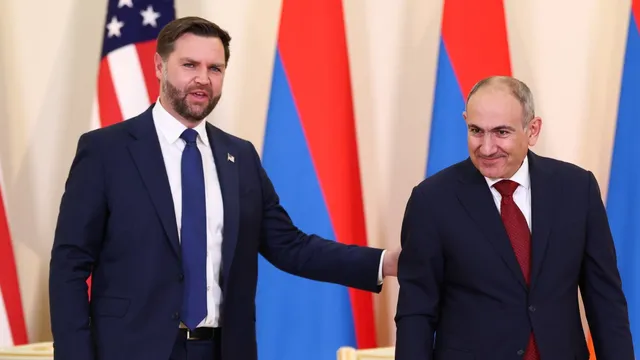
JD Vance visits Armenia to broker peace with Azerbaijan
JD Vance visits Armenia to broker peace with Azerbaijan
- Vice President JD Vance met with Armenian Prime Minister Nikol Pashinyan to discuss ongoing conflicts with Azerbaijan and economic collaborations.
- As part of the U.S. efforts, agreements were signed to promote a civil nuclear energy deal and export technology to Armenia.
- Vance's visit holds historic significance as a push towards resolving long-standing tensions while reinforcing U.S.-Armenian relations.
Story
In February 2023, Vice President JD Vance landed in Armenia, marking a historic visit as no sitting U.S. president or vice president had ever been to the country. This visit coincided with ongoing diplomatic efforts to address a decades-long conflict between Armenia and Azerbaijan, specifically regarding the disputed region of Nagorno-Karabakh. The Trump administration aimed to promote economic opportunities for Armenia while also emphasizing the importance of peace negotiations. Vance's visit included meetings with Armenian Prime Minister Nikol Pashinyan, during which they discussed a civil nuclear energy deal and potential U.S. support in infrastructure development and advanced technology exports. The backdrop of this diplomatic mission is rooted in a long-standing conflict exacerbated by a brief but intense war in 2020, which allowed Azerbaijan to regain significant control over territories that had been held by ethnic Armenians since 1994. Following Azerbaijan's military actions in September 2023, there was a further significant shift in power dynamics, forcing Armenian leadership to reconsider their approach to negotiations with Azerbaijan. Vance's presence in Yerevan was intended to reinforce U.S. commitments and support as peace efforts evolved, a commitment reflected in the agreements signed between the two nations. During Vance's visit, demonstrators expressed dissent and skepticism regarding U.S. involvement and support for the Armenian government, highlighting the complexities of public sentiment in the region. Furthermore, the meeting underscored the multi-faceted nature of the U.S. strategy, which not only focuses on peace but also aims at building strong economic ties with Armenia as part of a broader stabilization plan that involves Azerbaijan as well. As the political landscape continues to shift following past conflicts, Vance’s statements emphasized a forward-looking approach to peace, discouraging a fixation on historical grievances and advocating for partnerships that benefit both nations. The deals discussed during Vance's visit are expected to foster cooperation and reduce tensions, but the ultimate success of these diplomatic efforts remains contingent on the willingness of both sides to commit to the long-awaited peace treaty.
Context
The history of the Armenia-Azerbaijan conflict is a complex and multifaceted issue that has deep historical roots, fueled by national identity, territorial claims, and ethnic tensions. At the heart of the conflict is the Nagorno-Karabakh region, which is internationally recognized as part of Azerbaijan but has been predominantly populated by ethnic Armenians. The roots of the conflict can be traced back to the early 20th century, particularly during the collapse of the Russian Empire and the establishment of the Soviet Union. Tensions escalated in the 1920s when the Soviet authorities placed Nagorno-Karabakh within the borders of Azerbaijan, which sowed the seeds for future disputes. The emergence of nationalist movements in the late 1980s led to a resurgence of conflict as both Armenia and Azerbaijan sought to assert their claims over the region, resulting in violent clashes and the eventual outbreak of war in the early 1990s following the dissolution of the Soviet Union. The first Nagorno-Karabakh War (1988-1994) resulted in significant territorial gains for ethnic Armenians, who established the Republic of Artsakh, a self-declared state. The war left thousands dead and created a large number of refugees, solidifying the deep animosities that characterize the conflict. A tenuous ceasefire was brokered in 1994, but the underlying issues remained unresolved, resulting in a protracted stalemate punctuated by sporadic violence. Diplomatic efforts to negotiate a lasting peace, primarily led by the OSCE Minsk Group, have struggled to produce meaningful results due to fundamental disagreements over territorial integrity, the status of Nagorno-Karabakh, and refugee return. In September 2020, tensions flared anew, leading to a serious escalation known as the Second Nagorno-Karabakh War, which lasted for 44 days and resulted in thousands of casualties. Azerbaijan, bolstered by military support and advanced technology, managed to reclaim significant territories that had been under Armenian control since the first war. The war concluded with a ceasefire agreement brokered by Russia in November 2020, which included the deployment of Russian peacekeeping forces in the region. The outcome of the conflict further reshaped the geopolitical balance in the South Caucasus, raising concerns among neighboring countries and international stakeholders. In the aftermath of the recent hostilities, both Armenia and Azerbaijan face internal challenges, including political instability and the need for reconciliation. The international community continues to monitor the situation, emphasizing the importance of dialogue and peaceful resolution. However, deep-seated mistrust and nationalism pose significant barriers to reconciliation. Looking forward, it is essential that both sides engage in constructive negotiations to find a sustainable solution that acknowledges the rights and aspirations of all affected populations, avoiding further escalations that could lead to catastrophic consequences in the region.


