

Trump's new plaques attack Biden and past presidents
Trump's new plaques attack Biden and past presidents
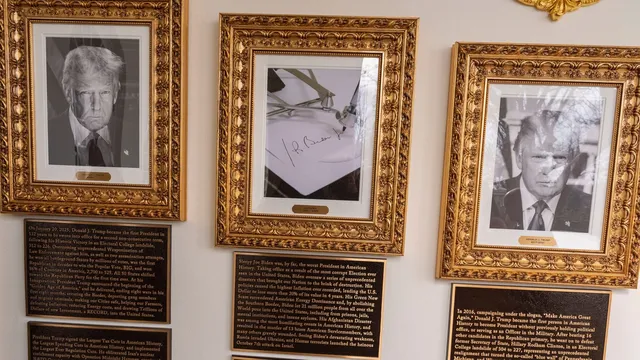
- Donald Trump's administration added plaques beneath presidential portraits.
- The plaques include critical remarks about his predecessors, especially Joe Biden.
- This selective portrayal of past presidents underscores a political narrative favored by Trump.
Story
In a recent addition to the White House, Donald Trump's administration has unveiled a series of plaques commemorating former presidents, located along the newly established 'Presidential Walk of Fame.' These plaques, many reportedly authored by Trump himself, have drawn significant attention for their contentious and critical descriptions of past leaders. Among the notable mentions is Joe Biden, referred to derogatorily as 'Sleepy Joe Biden' and labeled 'the worst president in American history.' Trump's criticism also extends to Barack Obama and George W. Bush, highlighting perceived shortcomings in their presidencies. The plaques not only provide a controversial take on the legacies of these presidents but also omit references to Democratic presidents' achievements, particularly their Nobel Peace Prizes. For instance, while Theodore Roosevelt is acknowledged for his role in ending the Russo-Japanese War, Obama's Nobel win is ignored. This selective recognition of history underscores the political narrative that Trump seeks to promote, positioning himself in stark contrast to his predecessors. Trump’s administration has positioned this display as an 'eloquent' representation of each president's legacy, according to White House Press Secretary Karoline Leavitt. The audacity of these inscriptions indicates Trump's willingness to reshape historical narratives to suit his agenda, especially given his claims regarding the bias of the Nobel Committee against him. The new plaques align with Trump's repeated assertions of being overlooked for a Nobel Peace Prize, emphasizing his self-portrayal as a significant player in global diplomacy. The unveiling of these plaques has drawn mixed reactions from the public and critics alike, with many seeing them as an attempt to rewrite history to bolster Trump's image rather than an objective evaluation of the impacts these leaders had on the nation and the world. As history continues to evolve, these narratives will likely spark debate and reflection on the legacies of these American leaders, especially in the context of Trump’s own contentious presidency.
Context
The Nobel Peace Prize is one of the most prestigious awards globally, established by the will of Alfred Nobel, the inventor of dynamite, in 1895. This award reflects Nobel's desire to recognize those who contribute to the promotion of peace and the resolution of conflicts. The Nobel Peace Prize has been awarded annually by the Norwegian Nobel Committee since 1901, and it is given to individuals, organizations, or movements that have demonstrated notable efforts toward achieving peace. The criteria for awarding this prize have evolved over the years, focusing on aspects such as denouncing violence, fostering diplomatic relations, and contributing to humanitarian efforts. Over the years, numerous Nobel Peace Prize winners have made significant impacts in their respective fields, advocating for peace, justice, and human rights. Notable laureates include Martin Luther King Jr., who was awarded the prize in 1964 for his role in fighting racial segregation through nonviolent activism; Nelson Mandela and Frederik Willem de Klerk, who jointly received the award in 1993 for their efforts to peacefully end apartheid in South Africa; and Malala Yousafzai, awarded in 2014 for her advocacy of girls' education in the face of violence. Each winner's contributions reflect the evolving nature of peace and the various methodologies that can be employed in its pursuit. Moreover, the selection process for the Nobel Peace Prize has often stirred controversy and sparked debate on what qualifies a candidate for such an honor. Critics argue that some laureates do not meet the ideals of the prize, citing examples like Henry Kissinger, awarded in 1973 for his role in negotiating a ceasefire in the Vietnam War, despite the ongoing conflicts in the region. These discussions bring forth complex questions about the role of the Nobel Peace Prize in global peace dynamics and its influence on public perception regarding conflict resolution and diplomacy. In contemporary times, the Nobel Peace Prize remains a symbol of hope and recognition of the efforts made towards achieving lasting peace. The prize not only honors those who have made significant contributions but also draws attention to ongoing struggles faced by many around the world. The Nobel committee continues to acknowledge a wide array of efforts — from grassroots movements to international campaigns — signifying a broader understanding of peace that transcends mere absence of war. As the world faces increasing challenges such as climate change, social injustice, and systemic conflicts, the importance of the Nobel Peace Prize endures as both a source of inspiration and a reminder of humanity's collective responsibilities toward fostering a more peaceful existence.


