

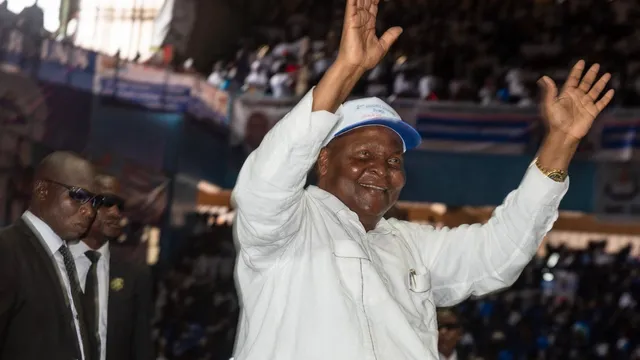
Touadera claims victory amid widespread fraud allegations
Touadera claims victory amid widespread fraud allegations
- Faustin-Archange Touadera was declared president-elect by the Constitutional Court with 77.9% of the vote.
- Opposition leaders alleged electoral fraud, which the government denied, leading to heightened political tensions.
- The election outcome may strengthen Russia's influence in the country, raising concerns about future stability.
Story
In the Central African Republic, on January 19, the Constitutional Court upheld the victory of Faustin-Archange Touadera in the disputed presidential election that took place on December 28. The election marked a significant moment as it handed Touadera, a mathematician who has been in power for ten years, a controversial third term. His main opponent, Anicet-Georges Dologuele, alleged that the electoral process had been marred by fraud even before provisional results were disclosed on January 5. Despite these claims, the government firmly dismissed the allegations. In this context, the courtroom declared that Touadera secured 77.9% of the total votes, while Dologuele received 13.5% and another contender, Henri-Marie Dondra, gathered 2.97%. Dondra later chose not to contest the results, emphasizing the need to maintain peace in a country that has endured significant political instability. The backdrop of this election involves a decade of turmoil in the Central African Republic, with various factions vying for power amid rampant violence. Elected initially in 2016, Touadera’s administration has relied increasingly on foreign military support, notably from Russian mercenaries and Rwandan soldiers, to stabilize the nation and counteract ongoing threats from rebel groups. In the run-up to this election, he campaigned heavily on his performance regarding national security, asserting his commitment to restoring order and negotiating peace deals with multiple rebel factions. However, these measures have not shielded his government from accusations of manipulation and electoral fraud. The election results have led to a polarized political landscape, with Dologuele asserting that there was a systematic effort to manipulate the electoral results. His claims have at least garnered some public support, sparking concerns about growing dissent within the populace. The electoral commission's announcement was met with a series of press conferences where both Dologuele and Dondra publicly condemned the process, underscoring the deep divide in opinions regarding the legitimacy of the election outcome. Touadera's re-election is seen to bolster not only his political influence but also aligns with the strategic interests of Russia in the region. The Russian government has been offering military and security assistance in exchange for resource access, including valuable minerals such as gold and diamonds. This interplay highlights the complexities of governance and international relations in a country grappling with persistent instability and the challenge of fostering genuine dialogue to bridge the widening gaps within society. Dondra's call for reconciliation underscores the urgent need for constructive political engagement moving forward as the Central African Republic navigates its uncertain future.


