

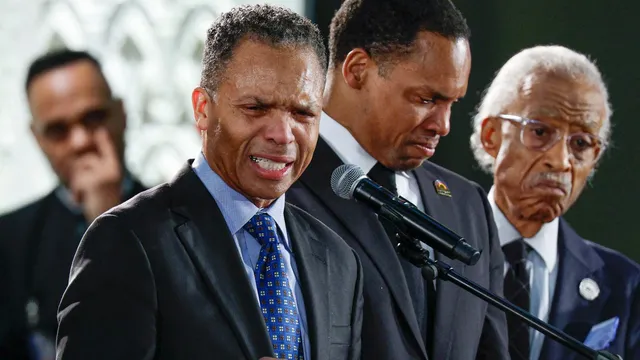
Barack Obama criticizes Trump at Jesse Jackson's memorial service
Barack Obama criticizes Trump at Jesse Jackson's memorial service
- Several prominent Democratic leaders gathered in Chicago to honor Reverend Jesse Jackson at his memorial service.
- Barack Obama and Joe Biden delivered tributes, with Biden making a controversial statement about intelligence.
- The service underscored Jackson's legacy and the continuing challenges faced by marginalized communities.
Story
In February 2026, significant figures from the Democratic Party gathered to honor the Reverend Jesse Jackson at a memorial service in Chicago, Illinois. Former Presidents Barack Obama, Bill Clinton, and Joe Biden were among the speakers who commemorated Jackson's impactful legacy in the civil rights movement. Obama highlighted Jackson's pioneering role in advancing Black political leaders, mentioning his presidential campaigns in the 1980s, which served as an inspiration for future candidates. Conversely, during his tribute, Biden made a controversial remark about being smarter than the audience, drawing attention on social media. Jesse Jackson Jr., however, rebuked the former presidents for lacking a genuine understanding of his father's deep commitment to marginalized communities and criticized any political narrative associated with his legacy. The memorial served to reflect both on Jackson's contributions and the ongoing socio-political challenges under current political leadership, particularly referencing the divisive climate fostered by Trump. This gathering was not merely a farewell but a profound acknowledgment of Jackson's lifelong dedication to civil rights and social justice, urging those present to carry on his mission in a time marked by profound political strife. In a nation still grappling with issues of equity and justice, the service was a reminder of Jackson's relentless voice advocating for the voiceless.
Context
Jesse Jackson is a prominent figure in the American civil rights movement, known for his unwavering dedication to social justice, political advocacy, and community empowerment. Born on October 8, 1941, in Greenville, South Carolina, Jackson rose to prominence as a key deputy to Dr. Martin Luther King Jr. during the struggle against racial segregation in the 1960s. His early involvement with the Southern Christian Leadership Conference (SCLC) helped shape his views on civil rights, justice, and equality, allowing him to develop invaluable organizational skills that would be integral to his future endeavors. Following King’s assassination in 1968, Jackson founded Operation PUSH (People United to Serve Humanity), which aimed to foster economic development and promote social change within African American communities through education, job creation, and advocacy for fair wages and business opportunities. Jackson's influence expanded beyond direct civil rights activism. He became a national figure through his two presidential campaigns in the 1980s, which marked a significant moment in the political landscape of the United States. His campaigns, particularly in 1984 and 1988, were pioneering as they sought to promote a distinctly African American agenda, emphasizing issues such as economic justice, healthcare, and education. Jackson's ability to galvanize voters and articulate the experiences of marginalized communities was transformative, as it not only mobilized black voters but also inspired a diverse coalition of supporters. Despite not winning the presidency, his candidacy challenged traditional political boundaries and paved the way for future leaders of color in American politics. In addition to his political efforts, Jackson consistently advocated for various social issues, including racial equality, LGBTQ+ rights, and anti-war sentiments. He was instrumental in global efforts to end apartheid in South Africa, participating in movements that united activists worldwide against racial injustices. His solidarity with international struggles contributed to a broader understanding of human rights that intersected with civil rights. Jackson’s appeals for peace and justice extended beyond national borders, as he sought to connect the struggles of African Americans with those facing oppression worldwide, further solidifying his legacy as a global advocate for justice. Throughout his life, Jesse Jackson has faced criticism and challenges, yet he remains a pivotal figure in the ongoing fight for civil rights. His ability to adapt to changing social climates while maintaining a distinct message of equality and empowerment has allowed him to remain relevant in contemporary discussions on race and justice. As we reflect on his contributions, it is clear that Jackson's legacy is deeply embedded in the fabric of civil rights history, serving as both a reminder of past struggles and a call to action for future generations to continue the fight for equality and justice.


