

Polar vortex disruption brings colder Thanksgiving to central U.S
Polar vortex disruption brings colder Thanksgiving to central U.S
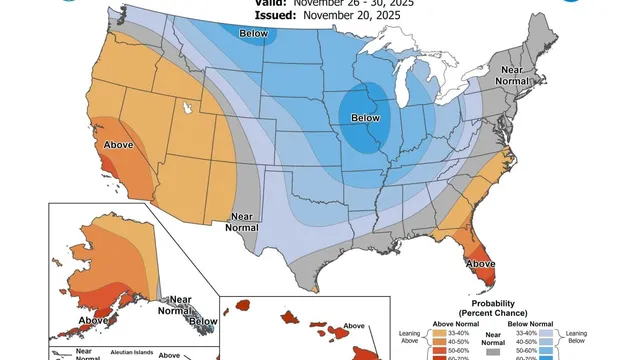
- The National Weather Service predicts colder than normal temperatures for much of the central and northern United States during the Thanksgiving week.
- Weather conditions may arise from a combination of factors, including a disturbance in the polar vortex.
- Travelers are advised to monitor weather forecasts due to expected colder temperatures impacting holiday travel.
Story
In the United States, colder-than-average temperatures are expected during Thanksgiving week from November 26 to 30, 2025. This forecast, issued by the National Weather Service (NWS), indicates that significant portions of the central and northern regions may experience below-normal temperatures due to a combination of climatic factors. The anticipated weather patterns include a potent disturbance of the polar vortex, sometimes described as a sudden stratospheric warming event, which allows frigid Arctic air to flow southward into the U.S. Such patterns are noteworthy as they may herald winter-like conditions, affecting travel and daily activities during a peak holiday period. The NWS highlighted that several states, including Missouri, Iowa, Illinois, and Wisconsin, have a high probability—up to 70 percent—of experiencing these colder temperatures. Furthermore, regions extending from northern Texas to parts of the eastern U.S., including New York, are expected to feel the chill. Given the close proximity of Thanksgiving, these cooler patterns raise concerns for the estimated 80+ million Americans planning to travel, prompting the NWS to remind travelers to check weather forecasts beforehand. While La Niña conditions, characterized by cooler Pacific Ocean surface waters, are presently influencing weather patterns, the Madden-Julian Oscillation (MJO) also plays a role. This recurring climate phenomenon can alter precipitation and wind patterns, exacerbating conditions leading to colder air being funneled down from the North Pole. In conjunction with the weakening polar vortex, which generally serves to contain Arctic air, disruptions from the MJO can result in significant temperature drops across large areas. The last La Niña impacted winter weather is particularly pertinent, as it correlates with drier conditions in some southern regions and wetter conditions for parts of the Midwest and Northwest. Moreover, experts like meteorologist Scott Handel from the Climate Prediction Center have noted that the patterns of precipitation observed are consistent with historical trends during La Niña events this time of year. With the potential implications of these weather shifts being profound, forecasters will continue monitoring developments closely as more data becomes available. The interplay between La Niña, the MJO, and polar vortex alterations highlights the intricate dynamics of climate science—factors that can considerably reshape holiday experiences for millions of Americans depending on the severity of the cold air outbreak.


