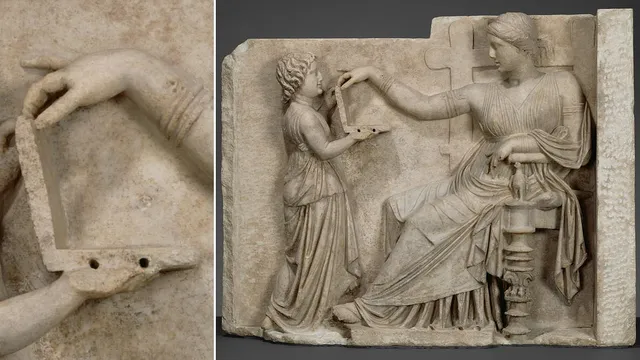
A 2,000-year-old Greek statue has recently drawn attention for its depiction of a woman who some claim is using a laptop. The statue, currently displayed at the J Paul Getty Museum in California, features a young servant girl holding a rectangular object that conspiracy theorists suggest resembles a modern laptop. While skeptics, including museum curators, argue that the object is likely a jewelry box, the statue has fueled discussions about time travel and the possibility of advanced technology existing in ancient times. Independent confirmation of these claims remains limited, and the interpretations of the statue vary widely among experts and enthusiasts alike.
The resurgence of interest in the statue coincides with a broader trend of individuals claiming to be time travelers, with various incidents reported where modern devices appear in historical contexts. For instance, a fan at Elvis Presley's final concert in 1977 was seen holding what looked like an iPhone, and a photograph from World War II shows a man seemingly using a cellphone. These instances have led to speculation about the existence of time travel and advanced technology in the past, although such claims lack substantial evidence.
Theories surrounding the statue and other artworks from Ancient Greece suggest that they depict individuals using devices resembling modern laptops, with some pieces dating back to around 500 BC. However, experts caution against jumping to conclusions, emphasizing that the interpretations of these artworks are often speculative. The museum has stated that the object in the statue is consistent with jewelry boxes depicted in other funerary reliefs, which adds to the uncertainty surrounding the claims of time travel.
While the mathematical principles of time travel have been discussed in relation to Einstein's theory of general relativity, there is currently no concrete evidence supporting the idea that humans can travel back in time or possess technology capable of doing so. The ongoing fascination with time travel narratives and the interpretations of ancient artifacts reflect a blend of curiosity and skepticism, highlighting the need for further investigation and reliable confirmation of such extraordinary claims.