

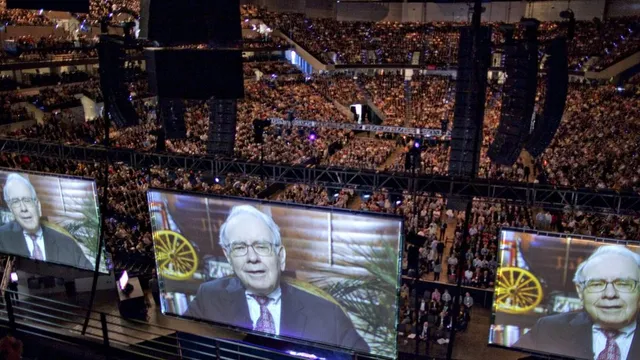
Berkshire meeting marks Warren Buffett's reduced role as he doesn't speak this year
Berkshire meeting marks Warren Buffett's reduced role as he doesn't speak this year
- Warren Buffett will attend the 2026 Berkshire Hathaway annual meeting but won't be speaking.
- Buffett remains the chairman and largest shareholder, holding substantial voting and economic interests.
- The meeting symbolizes a significant transition for the company as it adapts to Buffett's reduced direct involvement.
Story
In 2026, America hosts the Berkshire Hathaway annual meeting for the first time without Warren Buffett as CEO. This marks a significant transition as the 95-year-old Buffett remains active in the company but will not be speaking, as confirmed by the meeting schedule. Despite his reduced role, he continues to be the chairman of the board of directors and the largest shareholder, with a notable 30% voting interest in the company and an economic interest of 13.7%. Historically, Buffett has shared his investment insights through annual letters to shareholders, and this year is no exception, though his direct involvement is markedly less than in past years. Warren Buffett's legacy as a trusted investment strategist is solidified by over 80 years of experience in the financial sector, and his successor, Greg Abel, aims to continue this tradition. New reflections and insights shared by Buffett in previous years highlight his views on the American financial landscape, including caution against solely valuing short-term gains while emphasizing that long-term investments typically yield better outcomes. The current transition phase emphasizes a shift not just in leadership, but in the investment philosophy that has long characterized Berkshire Hathaway’s strategy. Buffett's reflections resonate with many, particularly as he pointed out the importance of understanding market fluctuations and positioning investments accordingly, maintaining a clear perspective on risks and national growth. He has expressed optimism in the American economy's capability to rebound and continue its historical trend of growth, reiterating this philosophy in various letters throughout the years. The meeting underscores the broader implications of leadership changes and investor expectations that accompany long-standing figures' decline in direct influence. As the company evolves, stakeholders look forward to how Abel will honor and adapt Buffett's lessons within a rapidly changing economic landscape, particularly regarding market participation and the emotional dynamics of investors. With a focus on stewardship, the company’s outlook remains cautiously optimistic regarding its trajectory under a new leadership style while reinforcing the unwavering principles Buffett has instilled over decades.
Context
Warren Buffett, often regarded as one of the most successful investors of all time, has developed a distinct investment philosophy that reflects his values and principles. Central to Buffett’s approach is the concept of value investing, which emphasizes purchasing stocks that are undervalued compared to their intrinsic worth. Buffett prefers to invest in companies that have demonstrated a strong track record of profitability, solid management, and a clear competitive advantage in their industry. This strategy is rooted in the teachings of Benjamin Graham, Buffett's mentor, who advocated for buying stocks at a price that is lower than their real value, thereby minimizing risk and maximizing potential returns over time. Buffett's investment philosophy also includes a strong focus on long-term holding. He famously states that his favorite holding period is “forever,” which highlights his belief in investing in high-quality companies that can weather market fluctuations and provide consistent returns over the long term. This approach contrasts sharply with more speculative short-term trading strategies. Buffett believes that the power of compounding interest combined with time can lead to significant wealth accumulation, thereby encouraging investors to adopt a patient mindset and resist the urge to react impulsively to market noise. In addition to value and patience, Buffett emphasizes the importance of understanding the businesses in which one invests. He advocates for the practice of conducting thorough fundamental analysis, which includes evaluating a company's financial statements, competitive advantages, management quality, and industry position. By focusing on businesses he understands well—often referred to as staying within one’s “circle of competence”—Buffett is able to make informed decisions that align with his risk-reward threshold. This principle also discourages unnecessary diversification, as it can lead to investing in unknown territories that do not align with an investor’s expertise. Finally, Buffett’s investment philosophy is underscored by a strong ethical framework. He believes in investing in companies that not only generate profits but also contribute positively to society. This approach highlights the importance of corporate governance and ethical business practices, as Buffett advocates for investing in firms with transparent operations and values that resonate with his own. By intertwining ethics with investment, Buffett not only seeks financial returns but also aims to create meaningful impact through his investment choices.


