
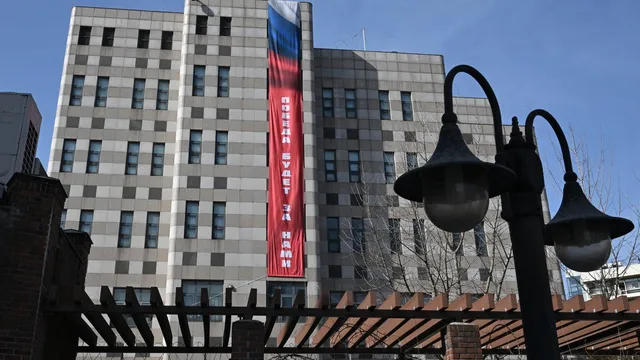
South Korea demands removal of pro-war banner from Russian embassy
- The Russian embassy in Seoul displayed a large banner in support of its war efforts in Ukraine.
- South Korea's Foreign Ministry requested that the embassy remove the banner, citing it as a violation of international law.
- The ongoing tension highlights the complexities in South Korea-Russia relations and military threats posed by North Korea.
Story
South Korea has formally requested the Russian embassy in Seoul to take down a large banner that reads "Victory will be ours," which was recently installed ahead of the fourth anniversary of Russia's full-scale invasion of Ukraine on February 22, 2026. The Korean Foreign Ministry expressed concerns that the banner constitutes a clear violation of international law and the United Nations Charter, as the ongoing conflict has significant legal and diplomatic implications. Despite the request, the Russian embassy has so far refused to comply, leading to mounting tensions between the two countries. The banner, measuring 15 meters and featuring the colors of the Russian flag, has been a source of unease for South Korea, particularly considering the country's consistent support for Ukraine. Officials in Seoul recall that Russia's invasion has been classified as illegal by both the UN and various international bodies. According to sources, the largest military cooperation between North Korea and Russia poses a further threat to stability in the region, making the situation even more alarming for South Korea's security interests. In addition to the banner issue, the South Korean government has been closely monitoring activities surrounding the embassy, including a potential pro-war rally scheduled for February 24, coinciding with the invasion's anniversary. This rally further underscores the ongoing tensions, as South Korea emphasizes that military collaboration between North Korea and Russia represents serious security risks. The diplomatic strain is compounded by public statements from Russian Ambassador Georgy Zinoviev, who lauded the involvement of North Korean troops in the conflict. This showcases the growing alignment between Russia and North Korea, which could destabilize the region, particularly as it relates to South Korea’s safety and its alliance with the United States. The South Korean government plans to keep an eye on future developments at the embassy as it navigates its foreign policy in response to this complex geopolitical situation.
Context
The history of South Korea-Russia relations is marked by a complex interplay of geopolitical interests, historical context, and evolving diplomatic strategies. The relationship can be traced back to the early 20th century, during the period of Russian imperial expansion in East Asia. Korea's annexation by Japan in 1910 briefly sidelined Russian interests; however, following the end of World War II in 1945, the Korean Peninsula was divided into North and South along the 38th parallel by U.S. and Soviet forces, establishing a new paradigm in Korean relations with Russia. While North Korea developed a strong alliance with the Soviet Union, South Korea initially aligned itself with the United States during the Cold War, creating divergent paths for the two Koreas in their relations with Russia. In the post-Cold War era, especially following the dissolution of the Soviet Union in 1991, South Korea sought to improve its relationship with Russia. This effort was characterized by economic cooperation and attempts at political dialogue. Various summits and exchanges occurred, including significant meetings between South Korean presidents and Russian leaders. The 1998 summit between South Korean President Kim Dae-jung and Russian President Boris Yeltsin marked a pivotal moment, as both nations aimed to deepen ties in trade and investment, underlining a mutual interest in peace and stability in the region. South Korea looked to diversify its diplomatic relations, while Russia aimed to regain its influence in East Asia. Throughout the 2000s, both nations took further steps to solidify their relationship, with South Korea becoming an important player in Russia's economic plans, particularly in energy and technology. The two countries engaged in various projects, such as the Seoul-Moscow axis in the realms of energy, trade, and investment. However, the relationship has faced challenges, primarily due to North Korea's nuclear program and its implications for regional security. Russia has often played a balancing act, maintaining its ties with North Korea while simultaneously seeking to deepen its relationship with South Korea. In more recent years, especially leading up to 2023, South Korea and Russia have continued to navigate this complicated terrain, focusing on pragmatic exchanges in trade and security. With South Korea's expanding economic interests in Russia and the Siberian region, as well as shared concerns about North Korea's provocations, the two nations have sought to cooperate on issues such as counter-terrorism and regional stability. As of now, the future of South Korea-Russia relations remains promising yet cautious, with both countries aware of the delicate balance of power and their national interests within the evolving dynamics of East Asia.
