

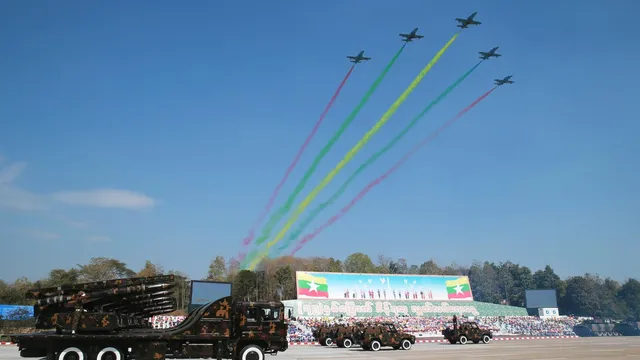
Myanmar military escalates air attacks using paramotors and gyrocopters
Myanmar military escalates air attacks using paramotors and gyrocopters
- The Myanmar military has been increasingly using paramotors and gyrocopters for aerial assaults on civilians and opposition forces.
- More than 7,700 civilians have been reported killed since the military took power in 2021.
- The rise in aerial attacks signifies a troubling trend in military tactics amidst ongoing civil conflict.
Story
In Myanmar, the military has ramped up its aerial assaults amidst an ongoing civil war that erupted following the 2021 coup. Reports indicate that the military employs low-tech aircraft such as paramotors and gyrocopters to target both civilians and anti-government forces. These aircraft provide an innovative way for the military to inflict damage from above, often dropping unguided explosives by hand. Notably, some attacks have resulted in significant loss of life, including the tragic incident in October 2023 where a paramotor attack killed at least 24 anti-election protesters. The use of these airborne tactics reflects the military's strategy of leveraging available technology to enhance its operational capabilities in conflict zones. Despite pushback from various ethnic groups and pro-democracy forces that have made territorial gains, the military's air capacity remains a critical factor in its sustained dominance in the battlefields across central regions of Myanmar. These circumstances have raised widespread alarm among human rights organizations, which have noted that over 7,700 civilians have been killed since the coup, while calls for international sanctions against the military's supply chains have increased. Concurrently, Amnesty International has reported rising concerns related to the importation of aviation fuel, which is allegedly being brought into Myanmar via 'ghost ships' that turn off their tracking systems to evade detection. The continued delivery of fuel is crucial for maintaining the military's aerial operations and, despite international sanctions, there has been a notable rise in the volume of aviation fuel entering the country. These developments underscore the ongoing complexities of Myanmar's civil unrest and the challenges faced by those opposing military rule, as well as the global community's struggle to effectively curb the military's capabilities to conduct air raids that endanger civilian lives.
Context
The history of Myanmar's civil war is deeply rooted in the country's complex ethnic composition, colonial legacy, and military governance. Following independence from British colonial rule in 1948, Myanmar, then known as Burma, was plagued by ethnic insurgencies. Various ethnic groups sought greater autonomy and recognition, leading to a series of conflicts with the central government, dominated by the Burman majority. The primary groups involved in these ethnic conflicts included the Karen, Shan, Kachin, and Chin, among others. Over the decades, the civil war has ebbed and flowed, marked by ceasefires, peace talks, and renewed hostilities, contributing to a high degree of instability in the region and within the country. As of 2023, the landscape of these civil conflicts remains fragmented, with multiple groups engaging in armed resistance against the military government. The military, known as the Tatmadaw, has evolved its tactics through decades of engagement in these conflicts. Initially modeled on British military practices, the Tatmadaw adapted to guerrilla warfare as insurgent groups employed hit-and-run tactics, leveraging their knowledge of the local terrain. In response, the military developed counter-insurgency strategies that included not only direct combat but also psychological warfare, involving propaganda to undermine public support for insurgent groups. The intensity of the conflict has also given rise to allegations of human rights abuses, including extrajudicial killings, forced relocations, and sexual violence, which the military often deploys as strategic means to instill fear in populations supporting insurgents. In recent years, particularly following the military coup in February 2021, the dynamics of the civil war have shifted dramatically. The coup which ousted the democratically-elected government led to widespread protests and the formation of the People’s Defense Forces (PDF), a civilian-led militia that has gained prominence in the resistance against the Tatmadaw. Young civilians, previously uninvolved in conflicts, have taken up arms, leading to an unprecedented mobilization against military rule. This has not only intensified the fighting but has also altered the tactics employed by the military, which has resorted to increasingly brutal means to maintain control, such as airstrikes on civilian populations and systematic targeting of ethnic minorities. The international community has observed the evolving tactics and strategies of conflict with concern, especially given the humanitarian crisis stemming from the ongoing civil war. Aid organizations report millions of internally displaced persons and ongoing ethnic cleansing, particularly in areas like Rakhine State and the Kachin region. Diplomatic efforts have been largely ineffective, with ASEAN and other bodies struggling to mediate in the complex web of these long-standing conflicts. As Myanmar continues to grapple with its turbulent history, the prospects for peace seem elusive, dependent largely on a genuine dialogue among diverse factions and a commitment to addressing the root causes of the civil unrest.


