

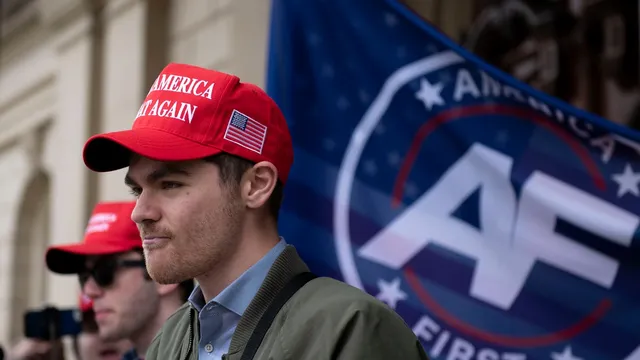
Nick Fuentes sparks division among right-wing factions after Tucker Carlson appearance
Nick Fuentes sparks division among right-wing factions after Tucker Carlson appearance
- Nick Fuentes' participation on Tucker Carlson's show sparked backlash within conservative ranks.
- The discussion centered around issues of identity, antisemitism, and the emerging ideological divides.
- The events highlight a significant internal struggle in the Republican Party regarding extremism and mainstream conservatism.
Story
In the United States, a recent interview featuring Nick Fuentes on Tucker Carlson's platform has triggered significant debate within conservative circles. Fuentes, a controversial figure known for his provocative views, has been accused of promoting antisemitism, particularly following his remarks regarding Jewish identity and political behavior. The conversation surrounding Fuentes raises questions about the evolving ideologies within the right-wing faction, particularly concerning its relationship with antisemitism. Figures such as Chris Rufo and Jonathan Keeperman have gained traction in conservative media, advocating against critical race theory and diversity initiatives, in contrast to the more extremist rhetoric often associated with Fuentes. The dialogue has further spotlighted generational differences within the right, particularly between younger individuals and older conservatives, showcasing a divide on issues such as identity and immigration. As Fuentes expresses views that may resonate with a specific segment of the younger right, his comments reflect broader societal tensions regarding race, identity, and nationalism. The emergence of figures espousing these controversial opinions marks a potential shift in the political landscape, challenging more traditional conservative views and complicating alliances within the party. Despite the controversial nature of Fuentes' ideology, there is evident interest and concern among mainstream conservatives about his rising influence, particularly as his rhetoric attempts to equate Jewish identity politics with the alleged practices of the political left. This debate touches on deeper issues surrounding antisemitism and race that have historically plagued not just the political right but society at large. Amidst this ideological clash, figures like Rufo and Keeperman seek to define a new conservative narrative that embraces certain aspects while distancing themselves from the extremities represented by Fuentes. As the Republican Party grapples with these internal conflicts, the consequences of this ideological battle may reverberate throughout future elections, as candidates are forced to navigate their positions concerning these divisive issues. This internal struggle could reshape party identity in the coming years, in a climate increasingly influenced by the dynamics of online media and grassroots activism. This pivotal moment underscores the need for conservatives to confront the specters of intolerance and division that have re-emerged within their ranks, questioning how they define themselves moving forward.
Context
The impact of antisemitism on the Republican Party has become a focal point of discussion in recent years, driven by rising hate crimes and the visibility of extremist groups. The party has faced increasing scrutiny over its handling of antisemitism, especially as members of the party have been accused of either condoning or failing to adequately address antisemitic sentiments. This has led to concerns among Jewish communities and civil rights organizations, which argue that ignoring these issues could damage the party's integrity and its relationship with diverse constituencies. Public perception of the Republican Party is increasingly tied to its stance on antisemitism, with many voters viewing a strong denunciation of hate as essential for political credibility. Additionally, the party’s base has been influenced by broader social media narratives that can perpetuate antisemitic tropes, further complicating the issue within the party’s ranks. Furthermore, the Republican Party's internal dynamics have also shifted in response to antisemitism. Some factions within the party have rallied around more extremist views, which can manifest in subtle or overt antisemitic rhetoric. This has caused a rift between traditional conservatives who seek to uphold longstanding principles of American democracy and those who may promote more divisive ideologies. As Republican leaders grapple with this internal struggle, they must also consider the consequences of their decisions on the broader electorate. The implications not only concern Jewish voters but also the perception of the party among other marginalized groups who may feel alienated by overtly bigoted attitudes. The normalization of antisemitic language and conspiracy theories in political discourse necessitates a proactive response from Republican leaders. Advocacy for clear anti-antisemitism policies and public condemnations of hate speech are critical for the party’s long-term sustainability. The lack of such measures can lead to a further estrangement from Jewish voters, who traditionally may have leaned toward Republican values. As antisemitism becomes intertwined with party identity, it will be essential for the GOP to articulate a distinct stance that promotes inclusivity and counters hate in all forms. Failure to do so risks not only alienating key voter demographics but also undermining the foundational ideals of the party itself, which have historically emphasized equality and liberty for all citizens. In conclusion, the impact of antisemitism on the Republican Party presents both challenges and opportunities. As the party navigates these complexities, its leaders must be mindful of the negative ramifications of inaction. By taking a clear and firm stance against antisemitism and promoting a message of unity and respect, the Republican Party can regain the trust of Jewish voters and others who are disillusioned by the current state of affairs. It is only through a commitment to combating hate that the party can hope to redefine its image and strengthen its electoral position in an increasingly pluralistic society.


