

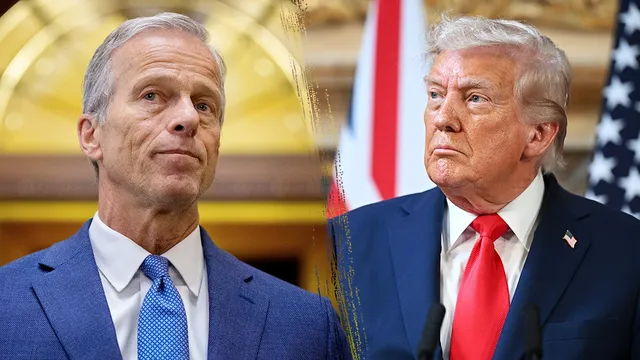
Trump slams Republicans for blocking U.S. attorney nominees
Trump slams Republicans for blocking U.S. attorney nominees
- President Trump was overheard expressing frustration over blocked U.S. attorney appointments.
- He criticized Senate Republicans for allowing the blue slip tradition to impede his nominations.
- The situation indicates a growing rift within the party and challenges in his administration's legal agenda.
Story
In the United States, President Donald Trump has been recorded on a hot mic expressing frustration over the hindrances he faces in appointing U.S. attorneys due to opposition from Senate Republicans. Speaking on December 8, 2025, after announcing a substantial $12 billion aid package aimed at assisting farmers, Trump was overheard lamenting, 'You know, I can't appoint anybody.' His complaint highlighted the expiration of time for several nominees he had previously put forward, leading to positions being left unfilled and resultant setbacks for his administration. The record of Trump's remarks sheds light on his ongoing battle with the Senate's 'blue slip' tradition, a practice that allows senators from a nominee's home state to veto presidential appointments. In this instance, Trump's pick for U.S. attorney in New Jersey, Alina Habba, faced substantial pushback from Democratic Senators Cory Booker and Andy Kim, effectively blocking her nomination. The president's frustrations reflect broader tensions within the Republican Party, wherein Trump holds fellow Republicans accountable for failing to eliminate or reform the blue slip tradition. Trump’s dissatisfaction is not merely about procedural roadblocks; it underscores the strategic difficulties he faces in filling key judicial positions within his administration. These appointments are critical as they influence various legal matters and the enforcement of laws across the nation. By being unable to appoint attorneys, Trump argues, his administration is left vulnerable, 'then we're losing.' He emphasizes the dire implications of these delays, suggesting that failure to secure Republican support leads him to consider Democratic nominees instead, which he views as an unfavorable outcome. This situation represents a significant internal struggle for Trump and the Republican Party, revealing fractures that could have longer-term implications for the coherence of the party and its ability to implement its agenda. In light of these challenges, Trump's comments raise urgent questions regarding the effectiveness of the Republican leadership in advancing the president's priorities and the future of party unity in the context of judicial appointments. As this story continues to develop, it illustrates the complex interplay of politics, party alignment, and the president's ongoing campaign to secure his judicial legacy.
Context
The blue slip tradition, a longstanding practice in the United States Senate, has significantly influenced the judicial appointment process, shaping the landscape of judicial nominations and confirmations. The term "blue slip" refers to a piece of paper that senators use to express their approval or disapproval of a judicial nominee from their state. When the nominee is proposed, the Senate Judiciary Committee sends out blue slips to the senators representing the nominee's home state, allowing them to weigh in on the nomination. This process is pivotal as it provides a mechanism for senators to assert their influence over judicial appointments, thereby fostering a sense of regional representation and accountability within the federal judiciary. The impact of the blue slip tradition on judicial appointments has evolved over time, manifesting variably across different administrations. Initially embraced as a tool for promoting bipartisanship, the blue slip tradition has also been criticized for enabling individual senators to obstruct nominees, particularly in cases where there is significant ideological divergence between the president and the senators. This aspect of the blue slip has led to instances where nominees who may have been otherwise qualified and capable face delays or outright denials due to partisan politics. As a result, the blue slip tradition can sometimes exacerbate tensions within the Senate, particularly when contentious judicial nominees are at stake, illuminating the fragile balance between senatorial courtesy and the president's prerogative to appoint judges. Moreover, the application of the blue slip tradition is distinctly influenced by shifts in Senate leadership and the political climate. In recent years, the trend has been for Senate leaders to relax or even disregard the blue slip's requirements under certain circumstances, reflecting a growing impatience with the gridlock that can arise from stringent adherence to this tradition. This shift highlights a tension between the desire for a cooperative confirmation process and the executive branch's need to fill judicial vacancies promptly. The decision to uphold or dismiss blue slip feedback ultimately falls to the Senate Judiciary Committee chair, who can control the advancement of nominations based on their interpretation of senatorial input. Consequently, the fate of various judicial nominees may hinge on individual senators' willingness to engage with the blue slip process, underscoring the nuanced power dynamics at play in the current judicial nomination landscape. In conclusion, the blue slip tradition remains a consequential element of the judicial appointment process. Its legacy is one of complexity: it serves as both a source of regional representation and a potential tool for legislative obstruction. As the political climate continues to evolve, so too will the interpretation and application of the blue slip tradition. Understanding its implications is essential for grasping the broader trends influencing judicial appointments in the United States, especially as both political parties navigate the delicate interplay between governance, representation, and the judiciary.


