

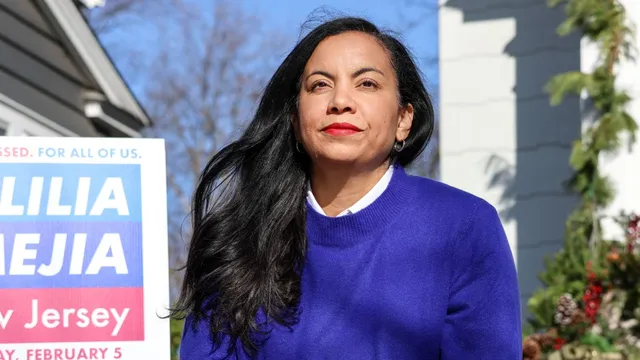
Analilia Mejia leads Republican Joe Hathaway by 17 points in New Jersey election
Analilia Mejia leads Republican Joe Hathaway by 17 points in New Jersey election
- Residents of New Jersey's 11th Congressional District voted in a special election on April 16, 2026.
- Polling indicates progressive candidate Analilia Mejia leads Republican Joe Hathaway by 17 points.
- The outcome will impact party strategies for the upcoming November midterms.
Story
In New Jersey's 11th Congressional District, voters participated in a special election on April 16, 2026, to fill the House seat vacated by Mikie Sherrill, who became the state governor. Progressive activist Analilia Mejia faced Republican Joe Hathaway in a race that appears to favor Mejia significantly, with polling indicating a 17-point lead for her. The situation is particularly challenging for Republicans, as the district has more registered Democrats than Republicans, by a margin of over 61,000. This special election is being closely monitored as it has broader implications for the upcoming November midterms. As the election unfolds, the nonpartisan Cook Political Report classified the race as 'Solid D,' reflecting the Democratic stronghold in the district. Currently, Republicans are holding a majority in the House with 218 seats, while Democrats hold 213. A win for Mejia would not only bolster the Democratic presence but would also tighten Republican margins, allowing for little room for losses in party-line legislation. Additionally, this election serves as an important indicator for Republicans, highlighting that distancing from Donald Trump may be necessary in battleground areas where approval ratings are declining. Mejia’s campaign heavily focuses on progressive values, securing endorsements from notable figures such as Senators Bernie Sanders and Elizabeth Warren. Hathaway, seeking to appeal to Conservative voters, has sharply criticized Mejia's progressive stance, branding it as 'radical socialism.' He has positioned himself as a voice of practical, bipartisan leadership, pledging to not be a 'rubber stamp' for the president. This messaging can resonate with voters concerned about extreme partisan policies as well. The electoral outcome will not only affect the immediate political landscape in New Jersey but will also potentially influence strategy among both parties as they prepare for the approaching elections. Democratic legislators may look to Mejia’s grassroots strategies and how they played into her expected success, while Republicans will be keen to hear how Mejia's handling of divisive issues, like the Israel-Palestine conflict, will resonate with different voter bases. The upcoming election serves as a barometer for how effective these parties will be at mobilizing their respective bases in this crucial phase leading to the larger electoral contests later this year.
Context
Presidential approval ratings play a crucial role in influencing election outcomes in the United States. Generally, a higher approval rating for an incumbent president correlates with better electoral prospects for their party during midterm and presidential elections. Conversely, lower approval ratings often signal potential losses for the party in power, as discontent among the electorate usually translates into voter behavior that favors opposition candidates. This dynamic is rooted in the perception of governance effectiveness, trust in leadership, and overall public sentiment about the nation's trajectory under current administration policies. Historically, data shows that when presidents maintain approval ratings above 50%, their party tends to retain or gain seats in the House and Senate during midterm elections, making the political landscape more favorable for them. For instance, notable cases like President Bill Clinton in 1998 and President George W. Bush in 2002 illustrate how robust approval ratings can lead to significant gains in congressional representation. In contrast, when approval ratings dip below this threshold, as seen with Presidents Barack Obama in 2010 and Donald Trump in 2018, the incumbent party usually faces significant electoral challenges. The impact of approval ratings is not merely limited to Congress but extends to state and local elections as well, where governors and state representatives are often influenced by the president's performance. Local candidates may choose to distance themselves from an unpopular president or align themselves closely with a popular one, depending on the prevailing mood among constituents. This strategic positioning is particularly evident in swing states, where local demographics and voting patterns can shift dramatically based on national sentiment, thereby affecting state-level outcomes. In conclusion, the relationship between presidential approval ratings and election outcomes underscores the importance of public perception in American electoral politics. Understanding this connection can provide valuable insights for candidates and political strategists alike, as they navigate the complex landscape of voter behavior. Monitoring approval ratings, particularly leading up to significant elections, offers a predictive tool for gauging potential electoral successes or setbacks. The cyclical nature of approval ratings not only influences immediate election results but also shapes the political climate in which future candidates must operate.


