

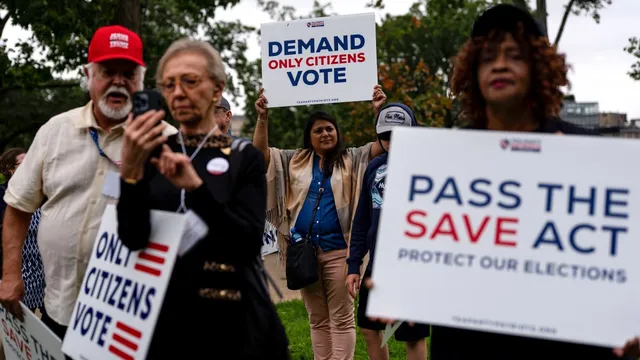
Trump demands passage of SAVE America Act or he will veto all bills
Trump demands passage of SAVE America Act or he will veto all bills
- President Trump stated he won't sign any bills until the passage of the SAVE America Act requiring proof of citizenship to register to vote.
- His demand has created political tension in Congress, with Democrats warning about potential voter disenfranchisement.
- Trump's ultimatum may lead to legislative gridlock, risking essential government funding bills.
Story
In the United States, Donald Trump asserted on Sunday that he would not sign any legislation until the SAVE America Act is passed. This legislation aims to overhaul voting laws by requiring proof of citizenship to register to vote, while Trump emphasized that any diluted version of the act would be unacceptable. He indicated that the SAVE America Act should take precedence over all other legislative matters, declaring it a core belief. In response to his stated position, Senate Minority Leader Chuck Schumer warned that such actions could undermine democracy and disenfranchise millions of voters, emphasizing the potential fallout from this ultimatum. The SAVE America Act is seen as a centerpiece of Trump’s agenda, designed to enforce stricter voter ID requirements across all states. With Trump's refusal to sign any other bills, which could include critical funding measures for various government departments, it has put Congress at a precarious standstill. Trump further expressed that he might consider shutting down the government over this legislative push, asserting his view that proving citizenship and voter identification must be a routine requirement akin to other identification needs in daily life, such as boarding planes. In the backdrop of this confrontation, Senate Majority Leader John Thune stated that altering Senate rules to facilitate the passage of the bill would not happen, illustrating the division among Republicans about how to approach the situation. Thune, who supports the SAVE Act, warned that a potential “talking filibuster” set by some Republican senators could lead to turmoil in the Senate, limiting opportunities to focus on other pressing legislative needs. The bill has already met significant resistance from Democrats, who argue that its implementation would disproportionately affect minority voters. As Trump insists on tying these contentious provisions to further legislative interactions, many analysts are now evaluating the broader implications of this strategy. Critics view Trump’s move as a political tactic to maintain base support ahead of upcoming elections. Still, as negotiations continue in Congress, the uncertainty surrounding the SAVE America Act looms large and may derail necessary legislative progress on an array of urgent issues, including funding for the Department of Homeland Security, which is currently facing financial hurdles. Many Republican lawmakers hope to compel a cohesive approach that could placate Trump while still allowing other crucial bills to move forward.
Context
The topic of voting rights has been a critical issue in American politics, particularly in the context of congressional debates. The landscape of voting rights is shaped by a series of legislative efforts aimed at expanding access to the ballot, protecting marginalized voters, and ensuring the integrity of the electoral process. Congress has been engaged in a number of discussions regarding the implementation of policies that address these concerns. The recent trends show a growing urgency to tackle voter suppression tactics, such as voter ID laws and purging of voter rolls, which disproportionately affect minority communities. The debates surrounding these issues reveal a deep division in Congress, with differing opinions on how best to enhance or restrict voting access. Activists and advocacy groups have continued to exert pressure on lawmakers, emphasizing the importance of safeguarding democracy by making voting more accessible to all citizens. Additionally, landmark legislation, such as the Voting Rights Act, has faced challenges in recent years, leading to calls for restoration and enhancement of its provisions. Debates within Congress have focused on re-establishing federal oversight of state voting laws and ensuring that changes to voting procedures do not infringe upon the rights guaranteed to citizens. High-profile cases and rulings have brought attention to the necessity of maintaining equitable voting standards nationwide. The ongoing discourse reflects differing philosophies on the role of federal versus state control in managing elections and whether Congress should be more proactive in regulating voting access to combat discrimination. In recent years, proposals such as the For the People Act and the John Lewis Voting Rights Advancement Act have surfaced as efforts to prioritize voting rights. These proposals aim to streamline the voting process, expand early voting, increase accessibility for disabled persons, and ensure that all citizens can participate in elections without undue burdens. However, bipartisan support remains difficult to achieve, with many Republicans arguing that such measures could lead to election fraud, despite evidence to the contrary. These tensions underscore the precarious balance between ensuring electoral integrity and facilitating broader access to the ballot, a critical aspect of the democratic process. Overall, the ongoing debates in Congress regarding voting rights highlight not only the complexities of American electoral politics but also the moral imperatives involved in fostering a fair democratic society. The outcome of these discussions will shape the future of voting in the United States and will have a lasting impact on citizen engagement and representation. As such, it is essential for Congress to find common ground and prioritize the protection and enhancement of voting rights to uphold the foundational principles of democracy.


