

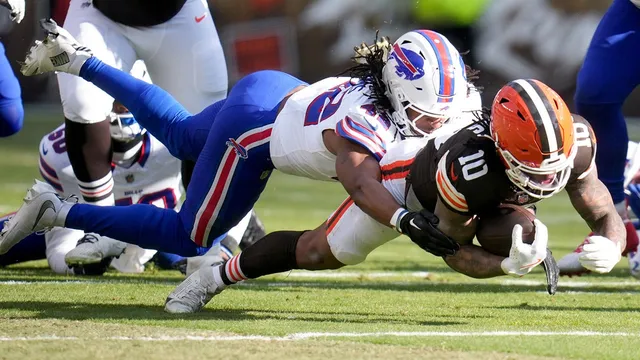
Cleveland Browns rookie Quinshon Judkins suffers season-ending injury
Cleveland Browns rookie Quinshon Judkins suffers season-ending injury
- Cleveland Browns rookie running back Quinshon Judkins suffered a serious leg injury while attempting to catch a pass during a game against the Buffalo Bills.
- Judkins was diagnosed with a dislocated ankle and a fractured fibula, which will require surgery and end his season.
- His performance this season included 805 rushing yards and 21 receptions as he quickly established himself as a key player for the Browns.
Story
On December 21, 2025, in a game against the Buffalo Bills, Cleveland Browns running back Quinshon Judkins left the field after sustaining a significant leg injury in the second quarter. Judkins, who had been one of the standout rookies for the Browns this season, was attempting to catch a pass when the injury occurred after being tackled by Bills linebacker Matt Milano. The play resulted in Judkins rolling on the ground in visible pain as his lower leg bent abnormally. Medical staff quickly placed an aircast on his lower right leg before he was carted off the field. Judkins had an impressive season leading up to the injury, accumulating 805 rushing yards and seven touchdowns across 13 games, along with 21 receptions for 142 yards. He was a second-round pick in the 2025 NFL Draft, chosen 36th overall, and was regarded as a key component in the Browns' future offensive strategy. Following the game, Browns head coach Kevin Stefanski confirmed the severity of the injury, revealing that Judkins had both a dislocated ankle and a fractured fibula, putting him out for the rest of the season and requiring surgery. As if the game was not already riddled with unfortunate events, not only was Judkins injured, but Minnesota Vikings quarterback J.J. McCarthy also exited his game against the New York Giants during the second quarter with a hand injury after a turnover. Additionally, Cardinals rookie Walter Nolen suffered a serious knee injury during the Cardinals' match against the Atlanta Falcons, which saw multiple other players on the team being checked for injuries. The injury events highlight a troubling pattern in the league, as multiple key players on several teams faced injuries during the games. The Browns, who have been struggling on the field this season, will need to regroup and consider how to move forward without Judkins, who had become a pivotal part of their offense.
Context
Injuries in the NFL have a profound and multifaceted impact on teams, influencing performance, team dynamics, and overall season outcomes. The inherent physicality of football contributes to a high incidence of injuries, which can range from minor sprains to severe orthopedic injuries that necessitate surgical intervention. Teams must cultivate a robust medical staff and employ advanced technologies for injury prevention and recovery. As each game progresses, the accumulation of injuries can lead to a strategic disadvantage, particularly when key players are sidelined. Star players often play pivotal roles in both player morale and team performance; thus, their absence due to injury can drastically alter a team's chances of success in a given season. Notably, the loss of quarterbacks, for example, tends to be a more significant blow to teams compared to injuries to other positional players, underscoring the critical nature of certain roles within the sport. Moreover, the impact of injuries extends beyond individual games, influencing long-term team strategies and roster decisions. Teams are often compelled to sign additional players, which not only changes team chemistry but also affects salary cap management. The NFL's unique structure, with a limited roster and strict salary cap, means that injuries can force teams into difficult positions, often requiring last-minute adjustments or deeper reliance on less experienced players. This can escalate the risk of further injuries due to insufficient depth in crucial positions, perpetuating a cycle of impact that can hinder a team's overall competitiveness throughout the season. Furthermore, the broader implications of injuries can resonate within the league, affecting playoff standings and even the drafting strategies of teams looking to secure a more robust roster. In terms of measurable outcomes, statistics illustrate that teams sustaining higher rates of injuries often find their win-loss record adversely affected. Certain studies highlight that teams with fewer injury-related setbacks tend to perform better, especially during the latter part of the season when fatigue becomes a significant factor. Moreover, teams with a strong emphasis on player health and injury prevention tend to foster more resilient lineups capable of enduring the rigors of a grueling 16 to 17 game season. Continued research and innovation in training techniques, rehabilitation practices, and biomechanical analysis are essential for NFL teams striving to minimize injuries and their associated impacts. Ultimately, the ability to navigate the challenges posed by injuries is a crucial aspect of NFL success, impacting not just individual games, but the entirety of a team's season and future prospects.


