

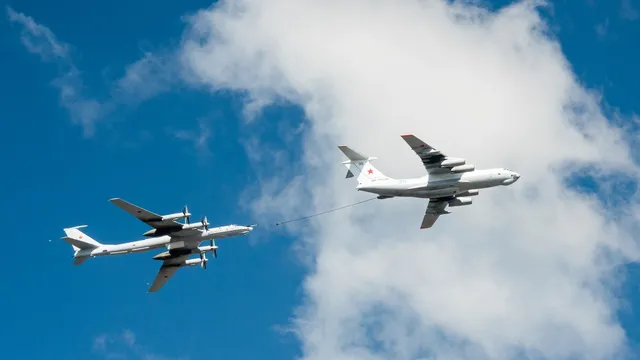
NORAD scrambles jets as Russian military aircraft approach Alaska
NORAD scrambles jets as Russian military aircraft approach Alaska
- NORAD detected two Russian TU-142 military aircraft in the Alaskan and Canadian ADIZ.
- A large contingent of U.S. and Canadian military aircraft was deployed to respond.
- Such operations against Russian aircraft are regular occurrences and are not viewed as a threat.
Story
On March 4, 2026, the North American Aerospace Defense Command (NORAD) detected two Russian Tupolev TU-142 military aircraft operating in the Alaskan and Canadian Air Defense Identification Zones (ADIZ). In response to this detection, NORAD launched a significant military operation consisting of two U.S. Air Force F-35 fighter aircraft, two F-22 fighter aircraft, and two Canadian CF-18 fighter aircraft, supported by several tankers and an E-3 AWACS for airborne early warning. Despite the robust response, NORAD clarified that the Russian aircraft remained in international airspace and did not enter U.S. or Canadian sovereign airspace. Historically, such incidents have occurred regularly, with NORAD maintaining that these actions do not pose a threat to national security. The agency has reiterated its readiness to protect North American airspace, highlighting the ongoing tensions between NATO countries and Russia, particularly as Russian military aircraft frequently approach airspace close to NATO member states. In fact, similar incursions have been noted in past months, leading to an increase in military readiness and response protocols among both U.S. and Canadian forces. The relationship between Russia and NATO has been strained, with incidents of Russian aircraft buzzing NATO airspace elevating concerns over potential conflicts in the region. NORAD remains vigilant in monitoring these aerial activities and ensuring the safety and security of North American airspace.
Context
Tensions between NATO and Russia have escalated significantly in recent years, particularly since the annexation of Crimea by Russia in 2014. This aggressive move marked a shift in the dynamics of European security and relations between NATO, a military alliance formed to counter Soviet aggression during the Cold War, and Russia, which viewed NATO's expansion as a direct threat to its sphere of influence. The response from NATO included increased military exercises in Eastern Europe, the deployment of additional forces to member states bordering Russia, and a renewed focus on collective defense, as outlined in Article 5 of the North Atlantic Treaty. These developments were perceived by Russia as provocative, leading to a cycle of military posturing and heightened rhetoric from both sides. In addition to the military dimensions, the information warfare and cyber capabilities have become critical fronts in this conflict. Russia's activities in cyberspace have included attempts to influence elections in NATO member countries, spreading disinformation campaigns, and cyberattacks targeting infrastructure and governmental agencies. NATO, recognizing the significance of maintaining the integrity of democratic processes and national security, has diversified its strategies to include defensive measures against these non-traditional threats. Such measures reflect the alliance's adaptation to a broader understanding of security that extends beyond conventional military engagements. Diplomatically, efforts to ease tensions have been inconsistent. While channels of communication between NATO and Russia such as the NATO-Russia Council have been maintained, substantive dialogue has been stymied by mutual distrust and diverging strategic interests. Russia's continued support for separatists in Ukraine, its involvement in conflicts in Syria, and its military buildup near NATO borders have made it difficult for the alliance to trust Russia's intentions. Conversely, Russia seeks recognition of its influence in post-Soviet states and resents NATO's enlargement, which it views as encroachment. The complexity and gravity of these issues require a nuanced approach that takes into account the security concerns of both sides while actively seeking avenues for cooperation. Looking forward, the prospects for easing tensions remain uncertain. With NATO emphasizing its collective defense and deterrence capabilities, and Russia adamant about protecting its interests, the potential for miscalculation remains a critical threat. The international community watches closely, as actions taken by either side could set off wider repercussions, impacting global security dynamics. It is crucial that both NATO and Russia engage in measures to build trust and diminish hostility, including arms control agreements and crisis communication mechanisms. Such steps are essential for preventing conflict and ensuring stability in Europe, marking a challenging yet necessary path towards a more secure future.


