

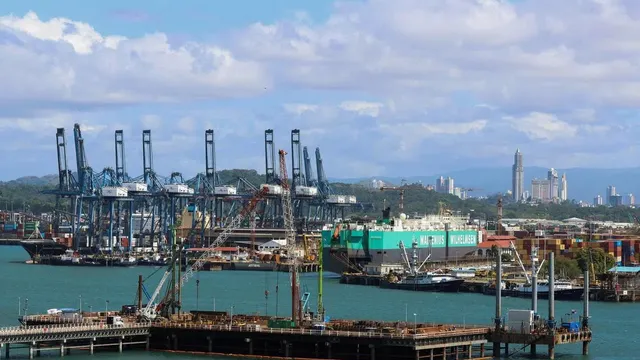
Panama court rules out Chinese control over canal ports
Panama court rules out Chinese control over canal ports
- Panama's Supreme Court ruled against the constitutionality of the contract held by CK Hutchison Holdings for the operation of canal ports.
- The ruling followed an audit that identified serious irregularities in the extension of the concession.
- This development aligns with U.S. efforts to curb Chinese influence in the region and has potential repercussions for the broader geopolitical landscape.
Story
In Panama, the Supreme Court ruled that the concession granted to CK Hutchison Holdings, a subsidiary of a Hong Kong company, to operate ports at either end of the Panama Canal was unconstitutional. This ruling, made public on January 29, 2026, arose from an audit conducted by the Panamanian Comptroller General that revealed irregularities in a 25-year extension granted to the company in 2021. The court found that the contract violated the Panamanian constitution by providing exclusive privileges and tax exemptions, compromising public interest and creating monopolistic conditions. The ruling has significant implications for U.S.-China relations, especially amid ongoing geopolitical tensions, as it aligns with U.S. efforts to lessen Chinese influence in Latin America. Following the ruling, President José Raúl Mulino assured that operations at the ports would continue and that a new bidding process for a long-term concession would be initiated. CK Hutchison's continued presence in Panama is now in question, as the company faces challenges in finalizing a major deal to sell its port stakes, which is complicated by Chinese government objections. The Supreme Court's decision underscores the complex interplay of national sovereignty, economic interests, and international relations surrounding the critical Panama Canal, which plays a vital role in global maritime trade.
Context
The Panama Canal, which connects the Atlantic Ocean and the Pacific Ocean, represents a crucial strategic asset for the United States, ensuring efficient maritime trade routes and military mobility. Since the canal's opening in 1914, it has played a pivotal role in global trade, drastically reducing the travel distance for ships and allowing the U.S. and its allies to strategically position resources across oceans. The canal serves as a vital passageway for approximately 14,000 ships annually, facilitating the transportation of goods and military supplies that bolster U.S. interests domestically and internationally. As trade dynamics evolve, particularly with the rise of Asia as a global economic powerhouse, maintaining influence over the Panama Canal remains paramount for the U.S. to safeguard its economic and strategic interests in the region and beyond. Geographically, Panama's location renders it significant not only for trade but also for military strategy. Historically, control over the canal has provided the U.S. military with rapid deployment capabilities, enabling quicker response times to regional conflicts and humanitarian crises. Even after the transfer of control of the canal to Panama in 1999, the U.S. has maintained a vested interest in ensuring that the waterway remains open and secure. This interest is amplified by the potential threat of influence from rival nations seeking to establish a foothold in the region, which could disrupt U.S. access to this vital trade route. The continued relevance of the Panama Canal in the context of modern geopolitics cannot be overstated. With shifting geopolitical landscapes, particularly in Latin America and the Caribbean, the U.S. must remain engaged in Panama to protect its strategic interests. Consistent diplomatic efforts and economic partnerships are crucial for the U.S. to ensure that Panama remains an ally and partner, rather than succumbing to external pressures from nations that may challenge U.S. influence. This includes investments in infrastructure and economic support that can help keep the Panamanian economy stable and aligned with U.S. interests. Monitoring and adapting to the evolving dynamics around the Panama Canal is essential for U.S. policy-makers. The rise of technological innovations in shipping, such as larger vessels and automated systems, presents both opportunities and challenges for the canal's operations. Moreover, climate change and potential environmental concerns underscore the need for sustainable practices in managing canal activities. The U.S. must work collaboratively with Panama to address these challenges while capitalizing on the canal's strategic significance, ensuring that it remains a linchpin in global maritime trade for years to come.


