

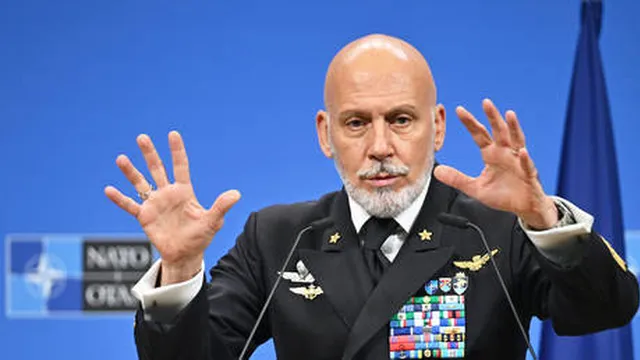
NATO considers pre-emptive strikes against Russia amid rising tensions
NATO considers pre-emptive strikes against Russia amid rising tensions
- NATO's top military commander, Admiral Giuseppe Cavo Dragone, indicated that member states are considering more aggressive actions against Russia.
- There is a growing demand from Eastern European diplomats for tougher responses, including retaliatory measures against hybrid attacks.
- These developments signal a potentially significant shift in NATO's military strategies, raising concerns about escalating tensions with Russia.
Story
In a recent interview with the Financial Times, Admiral Giuseppe Cavo Dragone, the chair of NATO's Military Committee, discussed the alliance's strategic options regarding Russia amidst ongoing tensions. NATO members are reportedly exploring a range of 'proactive' measures in response to what is characterized as Russia's hybrid warfare tactics. This discussion includes the possibility of pre-emptive strikes, which could be perceived as a defensive move. The admiral acknowledged that this approach diverges from NATO's customary strategic mindset, signaling a potential shift in military tactics among member states. The remarks came in the context of heightened concerns about Russian aggression and activities in Eastern Europe. Diplomatic opinions within NATO, particularly from Eastern European nations, have become increasingly vocal in advocating for stronger measures against Russia, including calls for retaliatory cyberattacks. Legal and ethical considerations, however, pose challenges for NATO's decision-making process. In September, NATO had already stepped up air patrols in Eastern Europe and the Baltic states due to alleged violations of airspace by Russian aircraft. Moscow, on its part, has rejected these claims, instead accusing NATO countries of escalating military tensions and conducting hybrid attacks against Russia. The fallout from these statements reflects the deteriorating relations between NATO and Russia, with Russian officials deeming NATO's plans and military posturing as unfounded provocations.
Context
NATO's military strategy against Russia has evolved significantly in response to the changing security environment in Europe and the re-emergence of Russia as a perceived threat. Following the illegal annexation of Crimea in 2014 and the ongoing conflict in Eastern Ukraine, NATO has prioritized deterrence and defense measures to ensure the security of its member states, particularly those in Eastern Europe. The strategy emphasizes a robust collective defense commitment, rooted in Article 5 of the NATO Treaty, which states that an attack against one member is an attack against all. This principle not only reinforces the alliance's unity but also serves as a powerful deterrent against potential aggression from Moscow. The NATO Response Force (NRF), which is a highly ready and mobile multinational force, has been enhanced in terms of size, capabilities, and readiness to respond to various scenarios, including hybrid warfare tactics often employed by Russia. In conjunction with increased troop deployments and readiness exercises along NATO's eastern flank, the alliance has developed a comprehensive deterrence strategy that includes enhanced air policing, maritime presence in the Baltic Sea, and improved command and control structures. These initiatives aim to reassure Eastern European member states, such as Poland and the Baltic countries, of NATO's commitment to their defense, while also improving the alliance's overall operational flexibility. Furthermore, NATO has invested in strategic airlift capabilities and logistics to ensure rapid deployment in case of a conflict. The alliance's focus has also shifted towards countering hybrid threats, which combine conventional and unconventional methods, such as disinformation campaigns and cyber attacks, targeting NATO member states and their democratic institutions. NATO has recognized the need to strengthen its partnerships beyond its traditional boundaries, enhancing cooperation with non-member countries and organizations. Engaging with nations such as Sweden, Finland, and Ukraine reinforces regional security and defense capabilities, contributing to stability in the region. Additionally, NATO conducts joint exercises and training programs with partner nations to improve interoperability and readiness. Diplomatic efforts to engage with Russia continue, albeit under a cautious framework, in order to manage tensions and to provide communication channels that can prevent misunderstandings that could lead to escalation. Overall, NATO's military strategy against Russia reflects a proactive and multifaceted approach, balancing deterrence and defense while maintaining readiness to adapt to evolving security threats. The alliance's commitment to collective defense, the enhancement of military capabilities, and the strengthening of partnerships are integral components of its strategy, aimed at ensuring the security and stability of its member states in the face of potential aggression.


